


Introduction
For decades, scientists have tried to fight malaria by reducing mosquito populations. However, mosquitoes play important roles in ecosystems, so eliminating them completely can create environmental concerns.
Because of this challenge, researchers are exploring a different strategy. Instead of killing mosquitoes, scientists are working to change them genetically so they can no longer spread malaria.
This innovative method uses a technology called gene drive, which could help stop the malaria parasite inside the mosquito before it ever reaches humans.
Understanding Malaria and Its Global Impact
Malaria remains one of the most serious infectious diseases worldwide. It spreads through the bite of infected mosquitoes carrying the parasite.
The disease is caused by a parasite called Plasmodium and is transmitted primarily by mosquitoes from the Anopheles mosquito group.
Each year, malaria affects millions of people, particularly in tropical and subtropical regions. Therefore, scientists continue searching for more effective ways to control its spread.
What Is Gene Drive Technology?
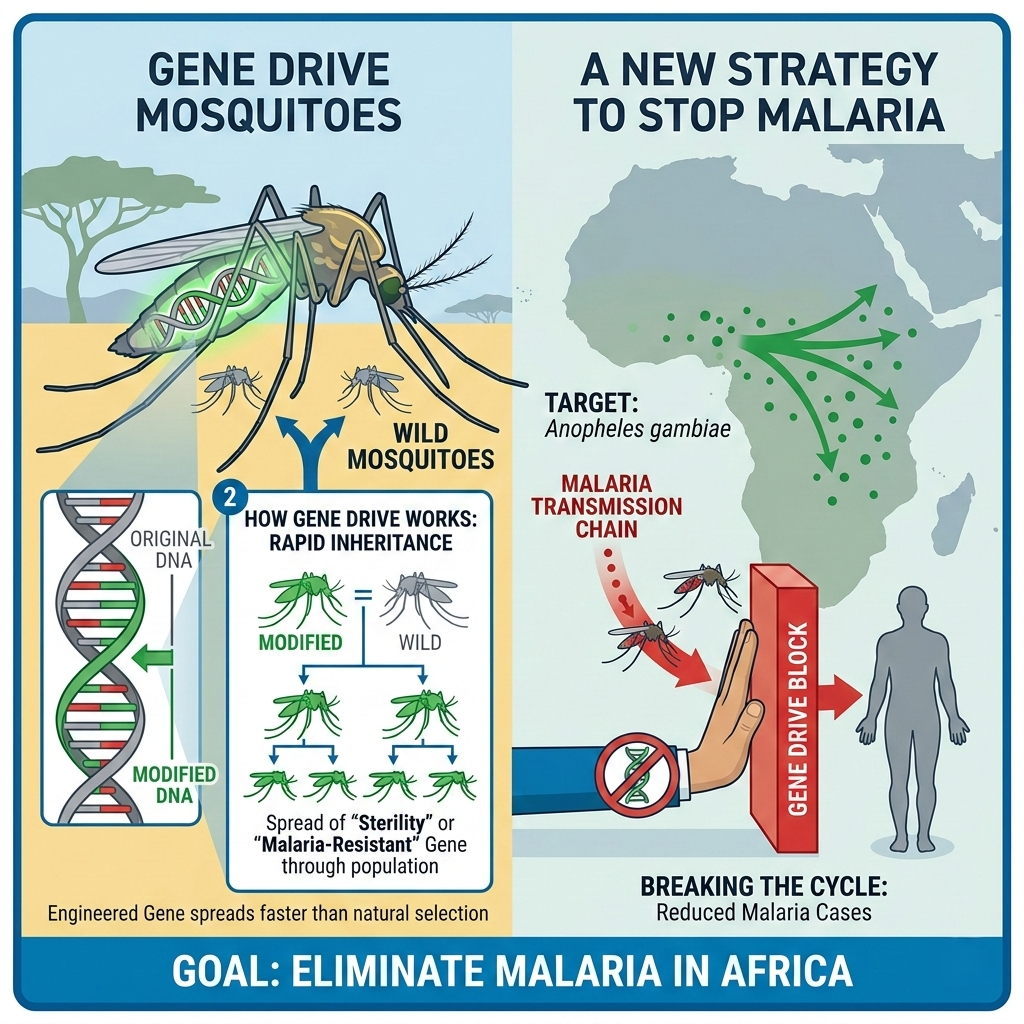
Gene drive is a powerful genetic engineering tool that changes how traits pass from parents to offspring.
Normally, an organism has about a 50% chance of passing a specific gene to the next generation. However, gene drive technology increases this probability dramatically.
As a result, the chosen genetic trait spreads quickly through a population over several generations.
Scientists hope this method can introduce beneficial traits into mosquito populations that reduce their ability to carry disease.
How Scientists Modify Mosquitoes to Stop Malaria
Researchers genetically modify mosquitoes so the malaria parasite cannot grow inside their bodies.
During a recent study involving gene-edited mosquitoes in Tanzania, scientists inserted genes that interfere with the parasite’s development.
These mosquitoes still
- Survive normally
- Reproduce naturally
- Continue living in their environment
However, the parasite struggles to survive inside them. Because of this, the insects become far less likely to transmit malaria.
Over time, gene drive technology could spread this protective trait across large mosquito populations.
Why This Approach Is Different
Traditional malaria control methods often focus on reducing mosquito numbers through insecticides or environmental changes.
Although these methods help, they also come with challenges such as resistance and ecological concerns.
The gene drive approach offers a different solution.
Instead of removing mosquitoes from the ecosystem, scientists aim to change their ability to carry disease.
Benefits of This Strategy
- Maintains natural mosquito populations
- Reduces parasite transmission
- Supports ecological balance
- Provides long-term disease control potential
Because of these advantages, many researchers view gene drive as a promising tool for future malaria prevention.
Real-World Research and Scientific Studies
The genetic mosquito research described here was published in the scientific journal Nature Communications.
In these studies, scientists tested gene-edited mosquitoes designed to resist malaria parasites.
Early results showed that the modified insects successfully limited parasite growth inside their bodies.
Although the technology remains under investigation, the findings suggest that gene drive could significantly reduce malaria transmission.
Safety and Environmental Considerations
Despite its potential benefits, gene drive technology raises important questions.
Scientists must carefully study how these modified genes behave in real ecosystems.
Key areas of research include:
- Environmental impact on local species
- Long-term genetic stability
- Effects across different climates
- Possible unintended ecological changes
Because gene drives spread rapidly, researchers emphasize cautious testing before any large-scale implementation.
The Future of Malaria Prevention
If proven safe and effective, gene drive mosquitoes could transform global malaria control strategies.
Unlike temporary solutions such as insecticides, genetic approaches may provide longer-lasting protection.
Scientists are also exploring similar strategies for other mosquito-borne diseases.
For example, gene-based approaches might eventually help reduce transmission of illnesses such as dengue fever or the Zika virus.
Although these ideas remain in development, they highlight how genetic technologies may reshape public health efforts.
FAQs
What is gene drive technology?
Gene drive is a genetic engineering method that increases the chance a specific gene will pass to future generations, allowing the trait to spread quickly through a population.
How does gene drive stop malaria?
Scientists modify mosquitoes so the malaria parasite cannot grow inside them. When these mosquitoes reproduce, the protective gene spreads to future generations.
Are gene drive mosquitoes already being released?
No large-scale releases have occurred yet. Researchers continue studying the technology to ensure safety and ecological balance.
Why not simply eliminate mosquitoes?
Mosquitoes play important roles in ecosystems, including serving as food for other animals. Removing them completely could disrupt natural environments.
Could gene-drive technology fight other diseases?
Possibly. Scientists are studying whether similar genetic approaches could reduce the spread of other mosquito-borne illnesses.
Final Thoughts
The development of gene drive mosquitoes represents one of the most innovative ideas in modern disease prevention.
Instead of trying to eliminate mosquitoes entirely, scientists are exploring ways to change how these insects interact with malaria parasites.
If future studies confirm the safety and effectiveness of this approach, gene drive technology could become a powerful tool in the global fight against malaria.
Although research continues, the concept demonstrates how genetics and biotechnology may help solve some of the world’s most persistent health challenges.
