


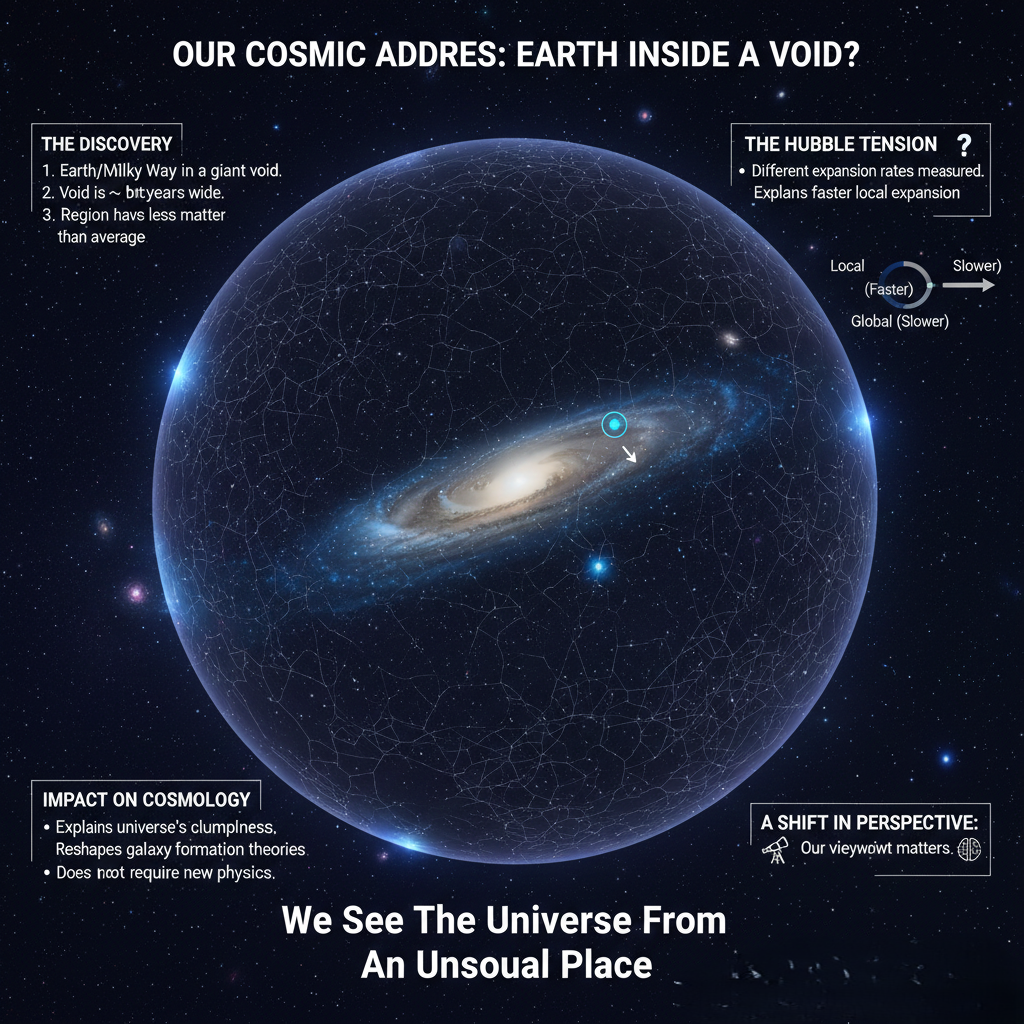
What if our place in the universe is far stranger than we thought?
A new study suggests Earth and the Milky Way may be drifting through a huge empty region of space, unlike most of the universe.
This surprising idea could change how scientists understand cosmic expansion.
What Is a Cosmic Void?
A cosmic void is a vast area of space with very little matter.
These regions contain fewer galaxies, stars, and dark matter than average.
They are not completely empty, but compared to other areas, they are extremely sparse.
How Big Is This Void?
Researchers estimate this void could be nearly two billion light-years wide.
That makes it one of the largest structures ever proposed.
If true, our galaxy would sit inside an unusually extreme part of the universe.
Why This Idea Shocks Scientists
For decades, scientists believed matter was spread fairly evenly across space.
This new research challenges that idea.
Instead, it suggests our cosmic neighborhood may be far from normal.
And that changes how we see the universe from Earth.
The Hubble Tension Explained Simply
The Hubble tension is a long-standing problem in astronomy.
Different methods of measuring the universe’s expansion give different results.
Some show the universe expanding faster than others predict.
This has confused scientists for years.
How a Cosmic Void Could Solve the Puzzle
If Earth sits inside a low-density region, space around us expands faster.
From our point of view, the universe would appear to be expanding more quickly.
But on a larger scale, expansion could still be slower and more uniform.
This means the mismatch may come from where we are, not new physics.
Why Scientists Take This Seriously
Researchers estimate it is 100 times more likely that we live inside a void than in a perfectly average region.
That makes this idea more than just speculation.
It offers a simple explanation without needing unknown forces or particles.
What This Means for the Big Bang
If confirmed, this discovery could reshape our understanding of:
- The universe after the Big Bang
- How galaxies formed
- How matter clumped together
- How large cosmic structures evolved
It would change how we interpret observations across the cosmos.
A Shift in Perspective, Not Physics
What makes this idea powerful is its simplicity.
It doesn’t require rewriting physics laws.
Instead, it suggests our cosmic address affects what we observe.
Sometimes, the problem isn’t the universe—it’s our viewpoint.
Frequently Asked Questions (FAQs)
Is Earth really inside a giant void?
Scientists believe it’s possible, but more observations are needed to confirm it.
Does this mean the universe isn’t expanding?
No. The universe is still expanding. The void may affect how fast it looks from Earth.
Why hasn’t this been noticed before?
Large cosmic structures are hard to detect and require precise data and models.
Final Thoughts
The idea that Earth sits inside a massive cosmic void is both strange and exciting.
It could explain one of astronomy’s biggest mysteries without exotic theories.
If confirmed, it reminds us of a humbling truth.
Our view of the universe depends on where we stand within it.
