


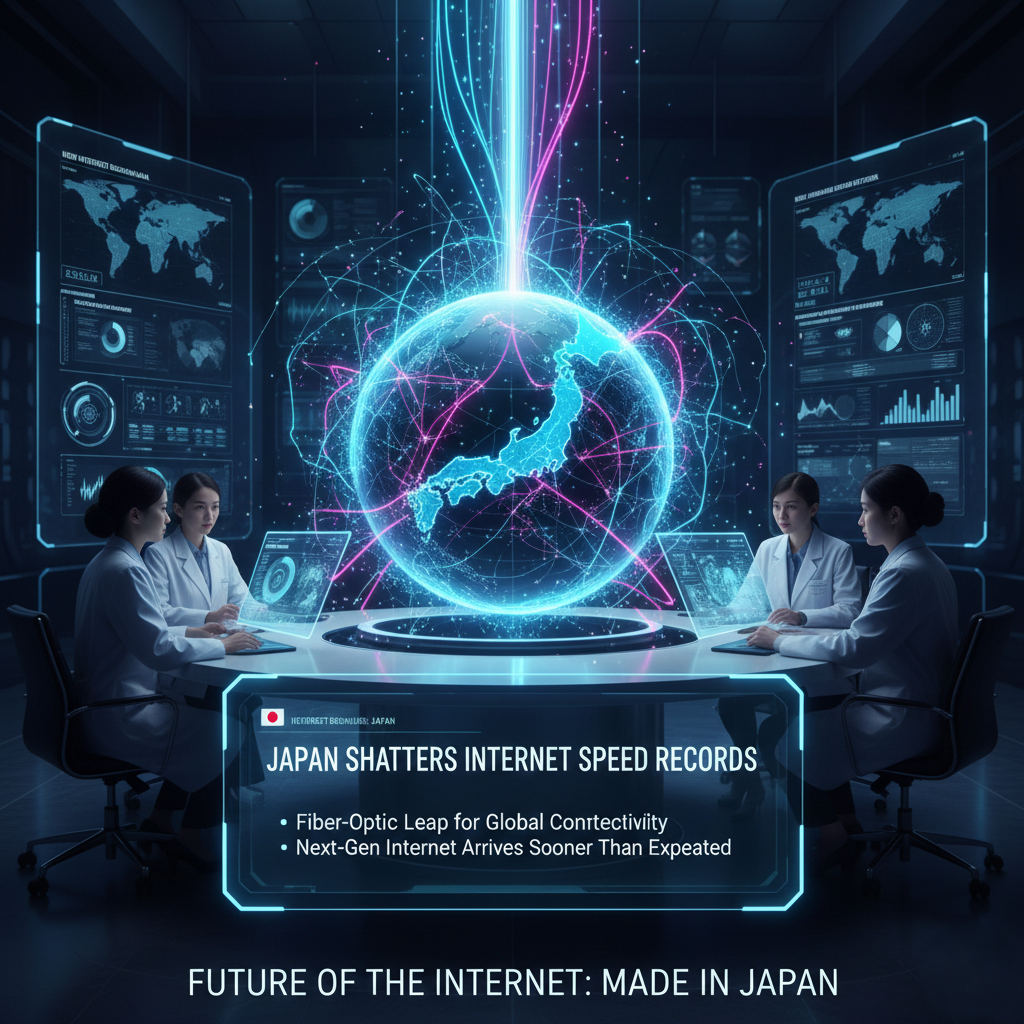
Japan has set a new benchmark for internet performance, shattering existing speed records and signaling a major leap forward for global connectivity.
Researchers successfully pushed fiber-optic data transmission speeds far beyond today’s commercial networks, offering a glimpse into what the next generation of the internet could look like.
Rather than a distant experiment, this breakthrough points toward a future that could arrive sooner than many expected.
A Breakthrough Built on Existing Fiber Networks
No Need to Replace the World’s Internet Cables
What makes this achievement truly transformative is its compatibility with existing fiber-optic infrastructure.
Instead of replacing global cables, future networks could be upgraded on top of what’s already in place.
This approach offers several advantages:
- Lower deployment costs
- Faster global adoption
- Greater scalability for developing regions
For countries hesitant about expensive infrastructure overhauls, this could make ultrafast internet far more attainable.
How Fast Is “Ultrafast,” Really?
While researchers haven’t framed this in consumer terms like download speeds, the performance leap is orders of magnitude beyond current broadband.
At these speeds:
- Entire data centers could sync in seconds
- Massive datasets could move across continents almost instantly
- Network congestion could become nearly irrelevant
This represents a structural change in how the internet behaves—not just incremental improvement.
Real-World Impacts Across Key Industries
Beyond Faster Downloads
This isn’t just about streaming or file transfers. The implications touch nearly every digital field.
Potential applications include:
- Latency-free VR and metaverse environments
- AI processing that feels instantaneous
- Cloud computing indistinguishable from local hardware
With near-zero delay, digital experiences could become smoother, more immersive, and more reliable than ever.
Transforming Critical Fields
From Finance to Medicine
Several high-stakes industries stand to benefit immediately once such speeds become practical.
These include:
- High-frequency financial trading
- Remote robotic surgery
- Advanced medical imaging and diagnostics
In these fields, even milliseconds matter. This breakthrough could redefine speed and precision standards entirely.
Accelerating Global Scientific Research
Collaboration Without Distance
Scientists say this advancement could dramatically accelerate research worldwide.
Massive datasets could move between institutions in seconds, fueling progress in:
- Climate modeling
- Space exploration
- Genomics and biotechnology
- Physics and materials science
Global collaboration would no longer be slowed by geography or bandwidth limits.
A World Where Distance Barely Matters
As data moves closer to real-time across continents, the concept of “remote” work and learning could fundamentally change.
Education, innovation, entertainment, and collaboration could unfold seamlessly from almost anywhere on Earth.
This hints at an internet where physical distance loses much of its relevance.
Frequently Asked Questions (FAQs)
Is this internet speed available to consumers yet?
No. This is a research breakthrough, not a commercial rollout yet.
Will existing fiber cables need replacement?
According to researchers, no. The technology builds on current fiber infrastructure.
When could this reach real-world networks?
Adoption timelines remain unclear, but compatibility with existing cables could speed deployment.
Final Thoughts
Japan’s record-breaking internet milestone is more than a technical achievement it’s a vision of a more connected world.
By enabling extreme speeds without rebuilding global infrastructure, this breakthrough brings the next internet era closer to reality.
As this technology matures, it could reshape how humanity connects, collaborates, and creates on a truly global scale.
