


Plastic pollution is no longer just about oceans and landfills.
It may now be inside the human body in ways we never expected.
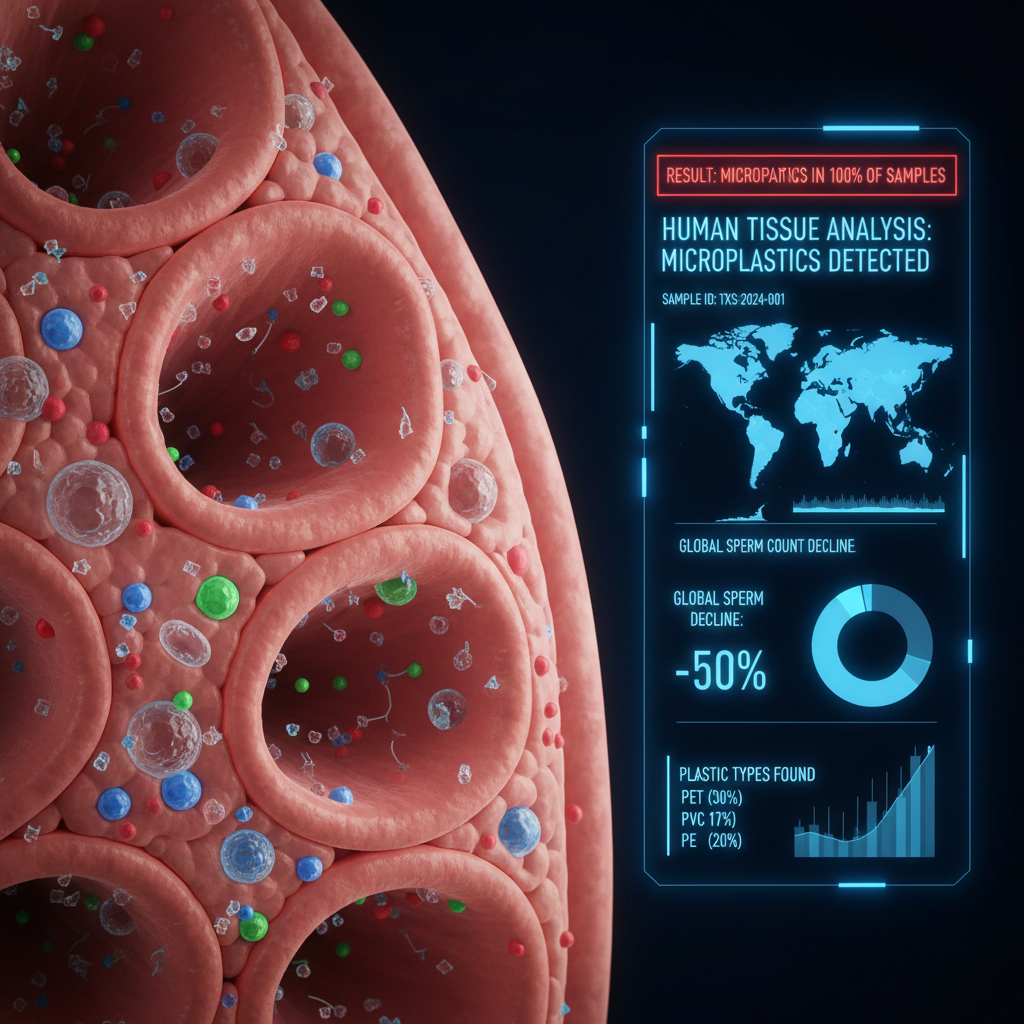
A recent study published in Toxicological Sciences revealed something alarming. Researchers detected microplastics in 100% of the human testicular tissue samples they examined.
Not most. Not some. Every single sample.
Let’s break down what this means, why it matters, and what scientists are still trying to figure out.
What Did the Study Actually Find?
Researchers analyzed donated human testicular tissue.
Their goal was simple: check whether microplastic particles were present.
The result was consistent across all samples.
Microplastics were detected in every single one.
These particles included common plastic types used in everyday products like
- Food packaging
- Bottled water containers
- Synthetic clothing
- Plastic storage materials
This confirms that plastic pollution has entered deep into human biological systems.
What Are Microplastics?
Microplastics are tiny plastic fragments that form when larger plastic items break down over time.
They are often smaller than 5 millimeters. Some are even microscopic.
Because they’re so small, they can enter the body through:
- Drinking water
- Processed food
- Seafood
- Breathing polluted air
Once inside, they may travel through the bloodstream and settle in tissues.
How Did Plastic End Up in Human Tissue?
Plastic is everywhere in modern life.
Over time, it breaks into tiny particles. These particles mix into:
- Soil
- Water supplies
- Indoor and outdoor air
When we eat, drink, or breathe, small amounts can enter our bodies.
Previous studies have already detected microplastics in:
- Human blood
- Lung tissue
- Placenta
Now, this new research adds testicular tissue to that list.
Could Microplastics Affect Male Fertility?
This is where things get serious.
Global sperm counts have been declining for decades. Some researchers suspect environmental factors may be involved.
The study does not prove that microplastics directly cause fertility problems. That’s very important.
However, scientists are exploring whether these particles could:
- Trigger inflammation
- Disrupt hormone balance
- Interfere with sperm production
At this stage, researchers are investigating correlation—not confirmed causation.
Still, the findings raise important questions about long-term reproductive health.
Why This Study Matters for Public Health
For years, plastic pollution was seen mainly as an environmental issue.
This research suggests it may also be a human health concern.
If microplastics can accumulate in reproductive organs, it changes how we think about exposure risks.
It also highlights the urgent need for:
- More long-term human studies
- Stronger environmental regulations
- Better plastic waste management
- Research into safer material alternatives
The problem is no longer “out there.” It may be inside us.
Real-World Context: Why Exposure Is Hard to Avoid
Modern life makes plastic almost impossible to escape.
For example:
- Bottled water often contains microplastic particles.
- Synthetic clothing sheds plastic fibers when washed.
- Food stored in plastic containers may absorb microscopic fragments.
Even indoor dust can contain plastic particles.
This constant low-level exposure adds up over time.
What Scientists Still Don’t Know
While the presence of microplastics is confirmed, many questions remain:
- How long do they stay in human tissue?
- Can the body remove them naturally?
- What concentration levels are harmful?
- Do certain plastic types pose greater risk?
These answers require years of careful research.
Science moves step by step—and this is just one important step.
FAQs
1. Does this study prove microplastics cause infertility?
No. The study shows presence, not direct cause. Researchers are still studying whether there is a clear link to fertility decline.
2. How do microplastics enter the body?
Mainly through food, drinking water, seafood, and inhaling air that contains plastic particles.
3. Can we remove microplastics from our bodies?
Currently, there is no confirmed method to remove accumulated microplastics from human tissues.
4. Should people be worried right now?
There’s no need for panic. But the findings highlight the importance of reducing plastic exposure and supporting further research.
5. What can individuals do to reduce exposure?
Some practical steps include
- Using glass or stainless-steel containers
- Avoiding heating food in plastic
- Filtering drinking water
- Reducing single-use plastic consumption
These actions may help lower exposure levels.
Final Thoughts
The discovery of microplastics in 100% of tested human testicular samples is a wake-up call.
It doesn’t prove harm yet. But it clearly shows that plastic pollution has crossed a new boundary.
What was once an environmental crisis may now be a biological one.
More research is urgently needed to understand the long-term effects. Until then, reducing plastic exposure where possible is a smart and practical choice.
