

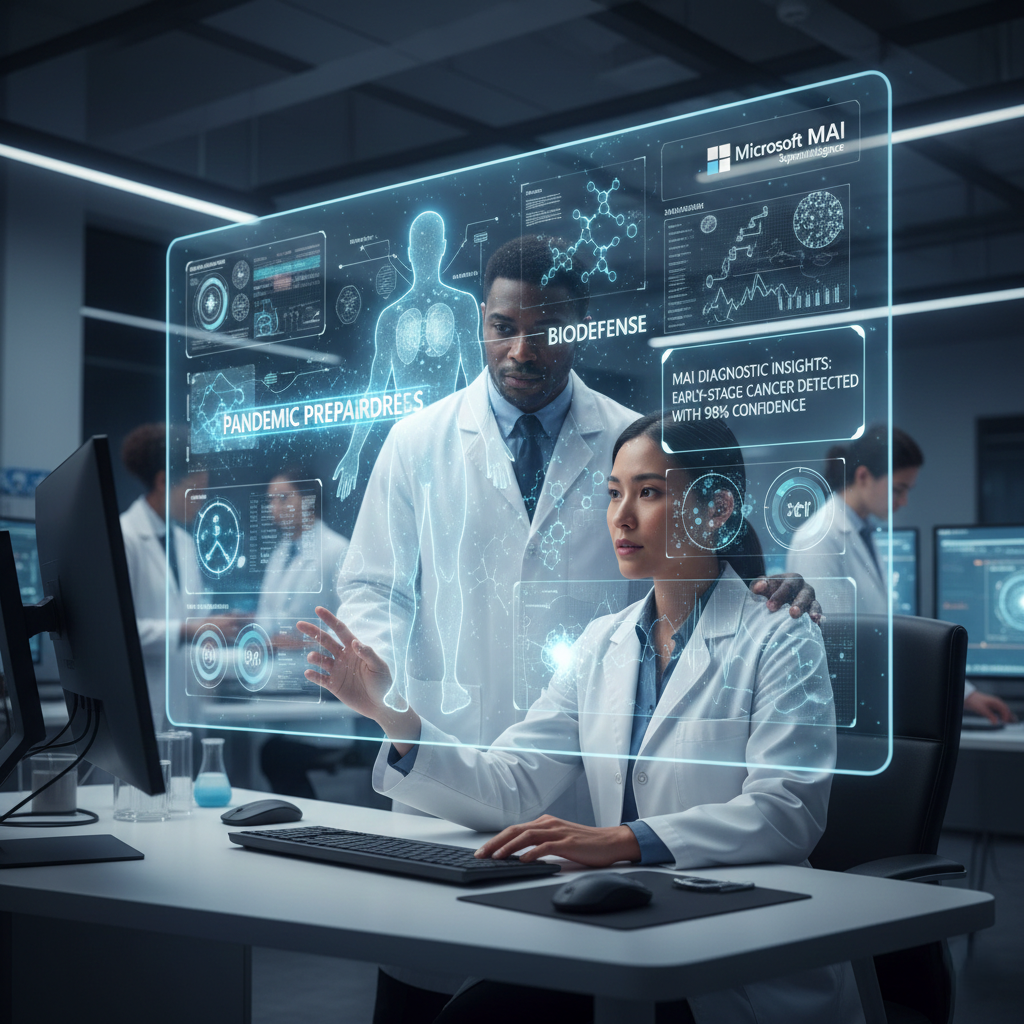
Artificial intelligence is moving fast. But instead of chasing sci-fi dreams, Microsoft is focusing on something very practical—helping doctors diagnose diseases more accurately.
The tech giant recently introduced the Microsoft MAI Superintelligence Team, a research initiative built around one big idea: use powerful AI to solve real-world problems, starting with healthcare.
This is not about building a robot that does everything. It’s about building smart systems that do one job extremely well.
Let’s break it down.
What Is the MAI Superintelligence Team?
The MAI Superintelligence Team is a new research effort inside Microsoft.
Its goal is simple but ambitious:
Build highly specialized AI systems that outperform human experts in specific tasks—with strong human oversight.
Instead of general artificial intelligence, Microsoft is focusing on task-specific intelligence. The first major focus? Medical diagnosis.
Why Start With Healthcare?
Healthcare is complex. Doctors deal with massive amounts of data every day:
- Lab reports
- Imaging scans
- Patient histories
- Genetic data
- Research studies
Even the best clinicians can miss rare patterns when time is limited.
AI systems can:
- Analyze thousands of data points instantly
- Compare symptoms with millions of case studies
- Suggest possible diagnoses faster
- Reduce unnecessary testing
The goal is not to replace doctors. It’s to give them a powerful support tool.
What Is “Humanist Superintelligence”? ”?
Microsoft describes its vision as humanist superintelligence.
That means:
- AI assists humans
- AI does not operate independently
- Human oversight stays central
- Doctors remain the final decision-makers
This approach is very different from the idea of fully autonomous AI. Instead of removing humans from the process, Microsoft wants AI to amplify human expertise.
Think of it like a super-powered assistant—not a replacement.
Early Results: Can AI Diagnose Better Than Doctors?
Early testing of similar AI systems has shown impressive results.
In controlled research settings:
- Some AI models identified complex conditions more accurately than groups of experienced clinicians
- They required fewer diagnostic tests
- They reduced potential costs
For example, in simulated diagnostic environments, advanced AI models analyzed case details step by step and reached conclusions with fewer unnecessary procedures.
That could mean:
- Faster diagnosis
- Lower hospital expenses
- Less stress for patients
However, there’s an important catch.
Success in testing environments does not automatically guarantee the same results in real hospitals.
The Real-World Challenges Ahead
Before Microsoft’s AI tools enter hospitals, several major hurdles must be solved.
1. Bias in Medical Data
AI learns from data.
If the training data is biased, the results may also be biased.
This is especially dangerous in healthcare, where fairness matters deeply.
2. Patient Safety
Even small mistakes in diagnosis can have serious consequences.
Any AI system must be:
- Extensively tested
- Clinically validated
- Continuously monitored
3. Regulatory Approval
Medical AI must pass strict regulations.
Health authorities require proof that systems are safe, reliable, and transparent before approving real-world use.
4. Trust From Doctors
Doctors must feel confident using these tools.
If the system cannot explain its reasoning clearly, adoption will be slow.
How This Could Change Medical Diagnosis
If successfully implemented, Microsoft’s MAI Superintelligence could transform healthcare in several ways.
Earlier Disease Detection
AI can identify subtle warning signs humans may miss.
This could help detect:
- Cancer at earlier stages
- Rare genetic conditions
- Complex multi-symptom disorders
Reduced Healthcare Costs
By minimizing unnecessary tests, hospitals could lower expenses for both institutions and patients.
Better Support for Overworked Doctors
Many healthcare systems face staff shortages.
AI could reduce mental workload by:
- Organizing patient data
- Highlighting critical risk factors
- Suggesting evidence-based insights
Instead of replacing clinicians, AI becomes a second brain.
Real-World Comparison: AI vs Traditional Diagnosis
Let’s compare the two approaches simply.
| Traditional Diagnosis | AI-Assisted Diagnosis |
|---|---|
| Relies on human memory and experience | Uses vast data models |
| Limited by time and workload | Processes data instantly |
| May require multiple tests | Can suggest optimized testing |
| Human-only reasoning | Human-machine collaboration |
The strongest model is not AI alone.
It’s human expertise combined with intelligent systems.
What This Means for the Future of AI in Healthcare
Microsoft’s MAI initiative shows a shift in AI development.
Instead of chasing artificial general intelligence, companies are focusing on high-impact, specialized AI systems.
Healthcare is just the beginning.
In the future, we may see similar models in:
- Climate research
- Drug discovery
- Engineering design
- Education systems
But medicine is where the impact could be immediate and life-changing.
FAQs
What is Microsoft’s MAI Superintelligence Team?
It is a new research group by Microsoft focused on building specialized AI systems to solve real-world problems, starting with medical diagnosis.
Will AI replace doctors?
No. The system is designed to support doctors, not replace them. Human oversight remains central to decision-making.
Is AI already better than doctors at diagnosis?
In controlled research settings, some AI systems have shown higher accuracy in certain cases. However, real-world hospital performance still needs validation.
What are the risks of AI in healthcare?
Key concerns include bias, patient safety, data privacy, and regulatory compliance.
When could this technology be widely used?
It will likely take several years of testing, regulatory approval, and clinical trials before widespread adoption.
Final Thoughts
Microsoft’s MAI Superintelligence Team signals a practical and focused future for artificial intelligence.
Instead of building machines that try to do everything, the company is targeting one of humanity’s biggest challenges: better healthcare.
If done responsibly, AI could become one of the most powerful diagnostic tools ever created—helping doctors make faster, smarter, and more informed decisions.
The future of medicine may not be human versus machine.
It may be human plus machine.
And that could change everything.
