


Modern warfare is changing rapidly. Drones, thermal cameras, and advanced sensors now play a major role in detecting troops on the battlefield.
Because of this shift, militaries are investing in new ways to protect soldiers from surveillance technology.
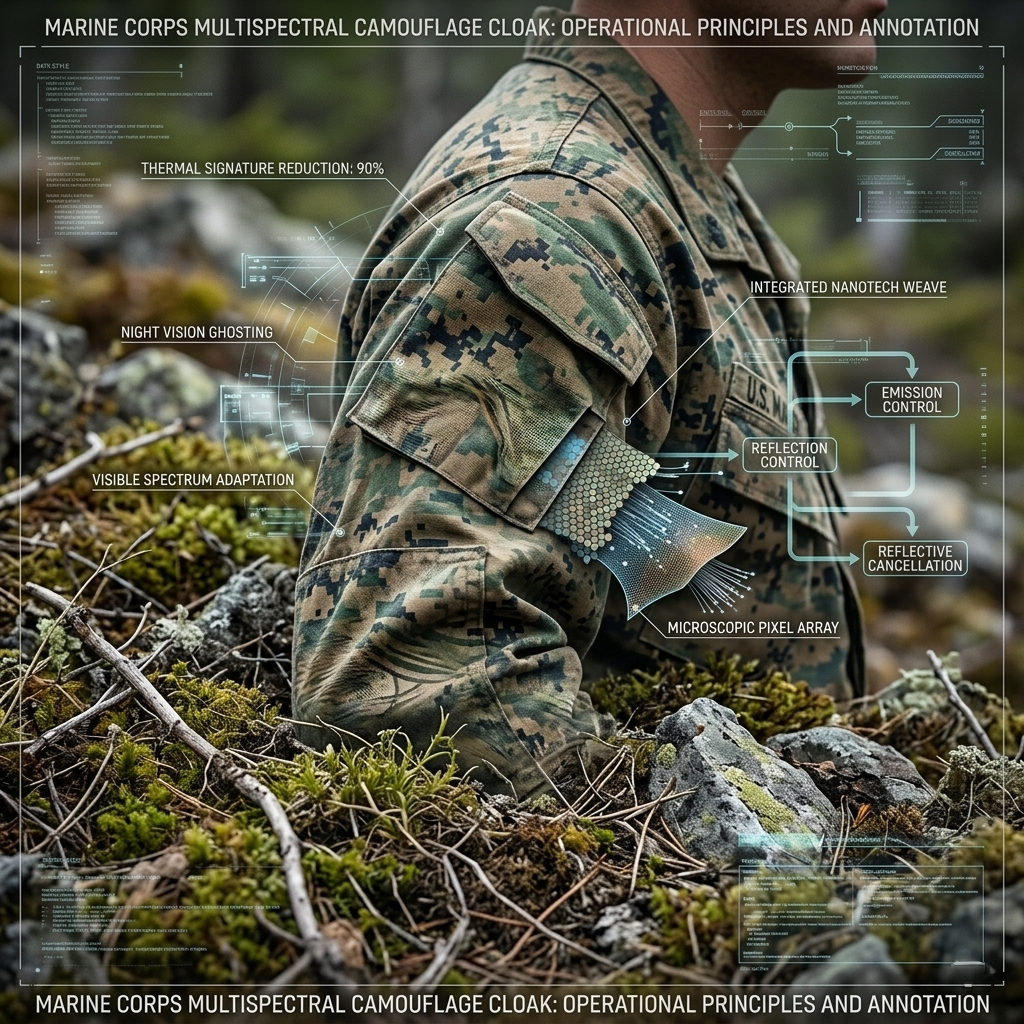
One example is a new system developed by the United States Marine Corps known as the Multispectral Camouflage Overgarment, often shortened to MCO.
Although it is sometimes described as a “camouflage cloak,” the technology is not true invisibility. Instead, it reduces how easily soldiers can be detected by multiple sensor types.
Why Modern Battlefields Require New Camouflage
Traditional camouflage mainly helps soldiers blend into natural environments.
However, modern surveillance systems rely on more than visible light.
Military drones and sensors now detect heat signatures and infrared radiation. As a result, even well-hidden troops may still appear clearly on advanced imaging systems.
Because of this challenge, the United States Marine Corps is developing camouflage designed to reduce detection across multiple sensor ranges.
What Is the Multispectral Camouflage Overgarment (MCO)?
The Multispectral Camouflage Overgarment is a lightweight cloak designed to cover a Marine’s existing uniform and equipment.
The garment helps reduce detection across several different electromagnetic bands.
These include:
- Visible light
- Near infrared (near-IR)
- Short-wave infrared (SWIR)
- Thermal infrared
By masking signals across these ranges, the cloak helps Marines remain harder to detect during reconnaissance or drone surveillance.
How the Camouflage Cloak Works
Instead of making a soldier invisible, the MCO disrupts the signals that sensors rely on to identify targets.
Different materials in the cloak help absorb or scatter energy from various parts of the electromagnetic spectrum.
For example:
- Special fabrics reduce heat signatures detected by thermal cameras
- Surface materials disrupt infrared reflections
- Camouflage patterns help break up visible outlines
Together, these features help reduce the chance that drones or surveillance systems can easily identify a soldier.
Key Features of the Marine Corps Camouflage Cloak
The MCO is designed for real battlefield conditions. Therefore, engineers focused on practicality as well as stealth.
Important Design Features
- Weight: under 3.5 pounds
- Quick deployment: easy to put on during missions
- Durable materials: suitable for harsh environments
- Compact storage: easy to carry in field gear
Because Marines must remain mobile, the cloak balances protection with lightweight design.
Detection Reduction Capabilities
The primary goal of the MCO is to reduce how easily troops can be spotted by advanced sensors.
According to program goals, the cloak may reduce detection at significant distances.
Estimated Detection Reduction
- Visual detection from aerial sensors: up to 1,000 meters
- Thermal detection: up to 5,000 meters, depending on conditions
Actual performance may vary depending on weather, terrain, and sensor quality.
However, even partial concealment can greatly improve survival during surveillance operations.
Deployment Plans for the Marine Corps
The United States Marine Corps plans to gradually introduce the camouflage system to operational units.
Initial procurement goals include:
- 13,000 cloaks by 2027
- Up to 61,000 cloaks by 2030
These numbers would allow the equipment to support a large portion of deployable Marine forces.
Because drone threats continue to increase, stealth gear like the MCO may become standard in modern combat environments.
Why Drone Detection Is a Growing Military Challenge
Unmanned aerial systems have become a major tool in modern warfare.
Drones equipped with cameras, thermal sensors, and AI-powered detection systems can identify targets from long distances.
Because drones operate continuously and quietly, they pose serious risks to troops on the ground.
Camouflage technologies like the MCO help counter these threats by reducing the visibility of soldiers to aerial surveillance.
The Future of Military Camouflage
The development of multispectral camouflage reflects a broader trend in defense technology.
Future camouflage systems may combine:
- Advanced materials
- Thermal masking technology
- Adaptive fabrics that change appearance
- Integration with electronic warfare systems
As battlefield sensors become more sophisticated, camouflage will also evolve to counter new detection methods.
FAQs
What is the Multispectral Camouflage Overgarment?
The Multispectral Camouflage Overgarment (MCO) is a protective cloak developed by the U.S. Marine Corps to reduce detection by drones and infrared sensors.
Does the cloak make soldiers invisible?
No. The cloak does not create true invisibility. Instead, it reduces detection across visible, infrared, and thermal wavelengths.
How much does the MCO weigh?
The cloak is designed to weigh less than 3.5 pounds, allowing Marines to wear it without significantly affecting mobility.
When will Marines receive the camouflage cloaks?
The Marine Corps plans to acquire about 13,000 units by 2027 and up to 61,000 units by 2030.
Why is multispectral camouflage important?
Modern sensors detect targets using multiple wavelengths of light. Multispectral camouflage reduces visibility across these ranges, improving soldier survivability.
Final Thoughts
The Multispectral Camouflage Overgarment represents an important step in adapting to modern battlefield threats.
As drones and advanced sensors become more common, traditional camouflage alone is no longer enough.
By reducing detection across visual, infrared, and thermal bands, this new cloak helps protect Marines from aerial surveillance.
Although it is not an invisibility cloak, it highlights how military technology continues evolving to meet the challenges of modern warfare.
Innovations like the MCO demonstrate that survivability in future conflicts will depend not only on weapons but also on advanced stealth and protective technologies.
