


Introduction: What If Robots Could See the Invisible?
Imagine a robot that doesn’t need a camera to “see.”
- No light.
- No direct view.
- No problem.
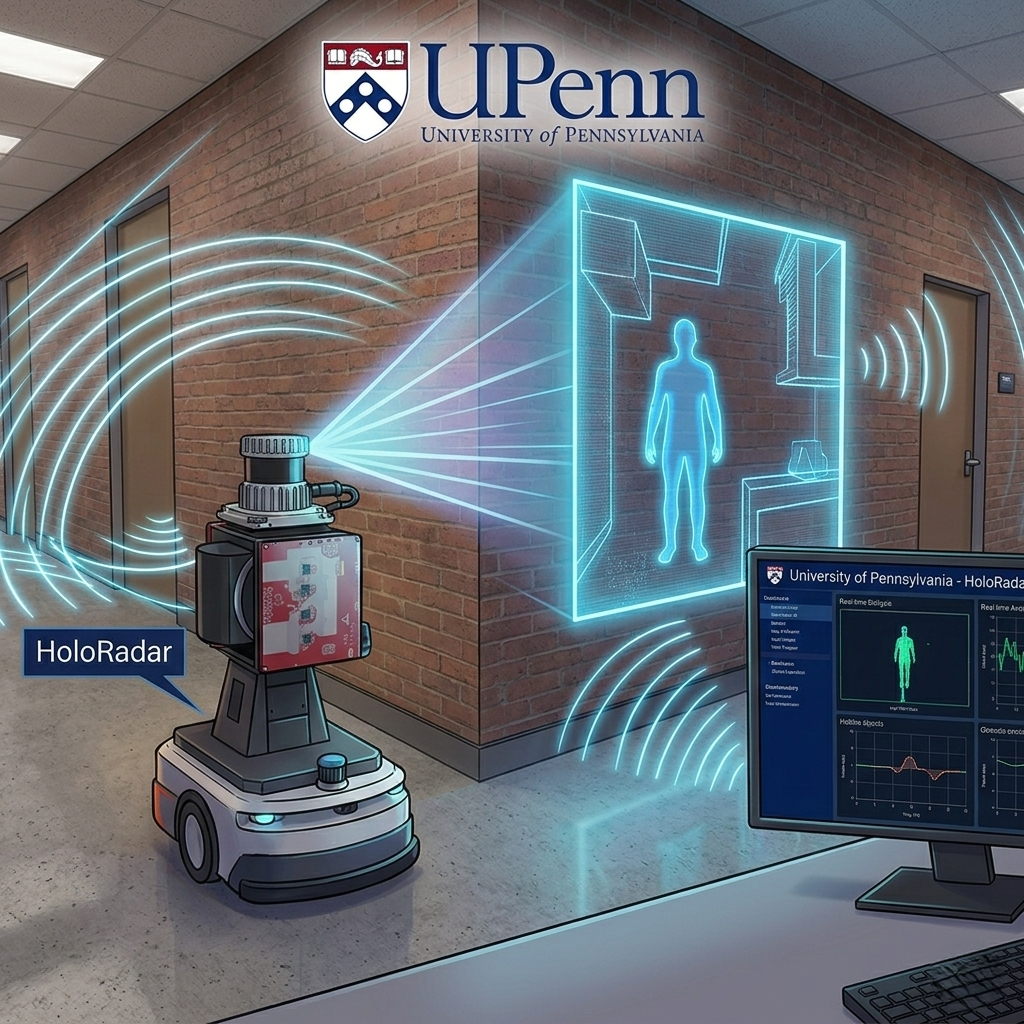
Researchers at the University of Pennsylvania have developed a powerful new system called HoloRadar. It allows robots to detect people and objects even when they’re hidden around corners.
This could completely change how machines move through the world.
What Is HoloRadar?
HoloRadar is an advanced AI radar system designed to help robots understand spaces they cannot directly see.
Instead of cameras or lasers, it uses:
- Radio waves
- Artificial intelligence
- Physics-based modeling
Together, these tools rebuild a 3D image of hidden spaces.
That means robots can “see” around corners, inside dark rooms, or through visual obstacles.
Why Traditional Vision Systems Fall Short
Most robots today rely on:
- Cameras
- LiDAR sensors
- Infrared systems
These tools work well in clear, well-lit environments.
But they struggle in:
- Darkness
- Smoke
- Changing light conditions
- Blind corners
If a person steps out from behind a wall, traditional systems may not detect them in time.
That’s where AI-powered radar changes the game.
How the AI Radar System Works
HoloRadar combines AI and physics in a smart, layered way.
Here’s a simple breakdown:
Step 1: Cleaning the Radar Signal
A neural network improves and filters raw radar signals.
This removes noise and makes the data clearer.
Step 2: Physics-Based Positioning
A physics model calculates where objects are located based on how radio waves bounce back.
This step adds accuracy and structure.
Step 3: Building a 3D Map
Another AI network creates a detailed 3D reconstruction.
It shows:
- Empty spaces
- Walls
- Hidden obstacles
- Moving people
The result is a realistic model of an area the robot cannot directly see.
Real-World Testing Results
Researchers tested HoloRadar in indoor environments like:
- Hallways
- Building corners
- Tight interior spaces
The system successfully reconstructed hidden structures and detected people with strong accuracy.
- These weren’t lab simulations only.
- They were real-world indoor tests.
- That makes the results much more promising.
Why This Technology Matters
Seeing around corners is not just impressive.
It can save lives.
Here’s where it could make a major difference:
1. Self-Driving Cars
Autonomous vehicles often face blind corners in cities.
AI radar could detect pedestrians before they step into the road.
That adds an extra safety layer beyond cameras.
2. Rescue and Emergency Robots
In smoky buildings or collapsed structures, visibility drops fast.
Radar-based robots could locate survivors without relying on light.
3. Warehouse Automation
Busy warehouses have moving workers and tight spaces.
Robots using AI radar could avoid collisions more effectively.
AI Radar vs. Cameras: A Quick Comparison
| Feature | Cameras | AI Radar (HoloRadar) |
|---|---|---|
| Needs light | Yes | No |
| Works in smoke | Limited | Yes |
| Detects hidden objects | No | Yes |
| Handles blind corners | No | Yes |
Cameras capture what’s visible.
AI radar understands what’s hidden.
The Bigger Picture: Smarter Robotics
Robotics is moving beyond simple automation.
We’re now seeing machines that:
- Predict movement
- Understand space
- Adapt to uncertainty
HoloRadar shows how combining AI with physics can unlock new capabilities.
Instead of replacing existing sensors, it could work alongside them.
That combination could make robots much more reliable in complex environments.
FAQs: AI Radar and HoloRadar
Does this mean robots can see through walls?
Not exactly like X-ray vision. The system uses reflected radio waves to reconstruct hidden areas, not to fully scan solid objects.
Is this technology ready for commercial use?
It’s still in the research phase, but strong indoor testing results suggest real-world applications are possible soon.
Could this improve autonomous vehicle safety?
Yes. Detecting pedestrians or obstacles near blind corners could significantly reduce accidents.
Is this better than LiDAR?
It’s not about better or worse. AI radar works in situations where LiDAR and cameras struggle, especially in low visibility.
What This Means for the Future of AI and Robotics
We are entering a phase where machines don’t just react.
- They anticipate.
- They analyze.
- They map hidden risks before humans even notice them.
- The AI radar system developed at the University of Pennsylvania could become a core safety feature in future robotics.
From smart cars to emergency responders, this technology has wide-reaching potential.
Conclusion: A Major Step Toward Safer Automation
HoloRadar proves that robots don’t need eyes to understand the world.
By combining AI with radio wave technology, researchers have created a system that sees beyond direct sight.
This innovation could make self-driving cars safer, rescue missions more effective, and automated workplaces more secure.
The next generation of robots may not just see what’s in front of them.
They may understand what’s around the corner.
