


For decades, nuclear waste has been one of the biggest concerns about nuclear energy.
Some radioactive materials remain dangerous for up to 100,000 years.
Now, scientists say that may change.
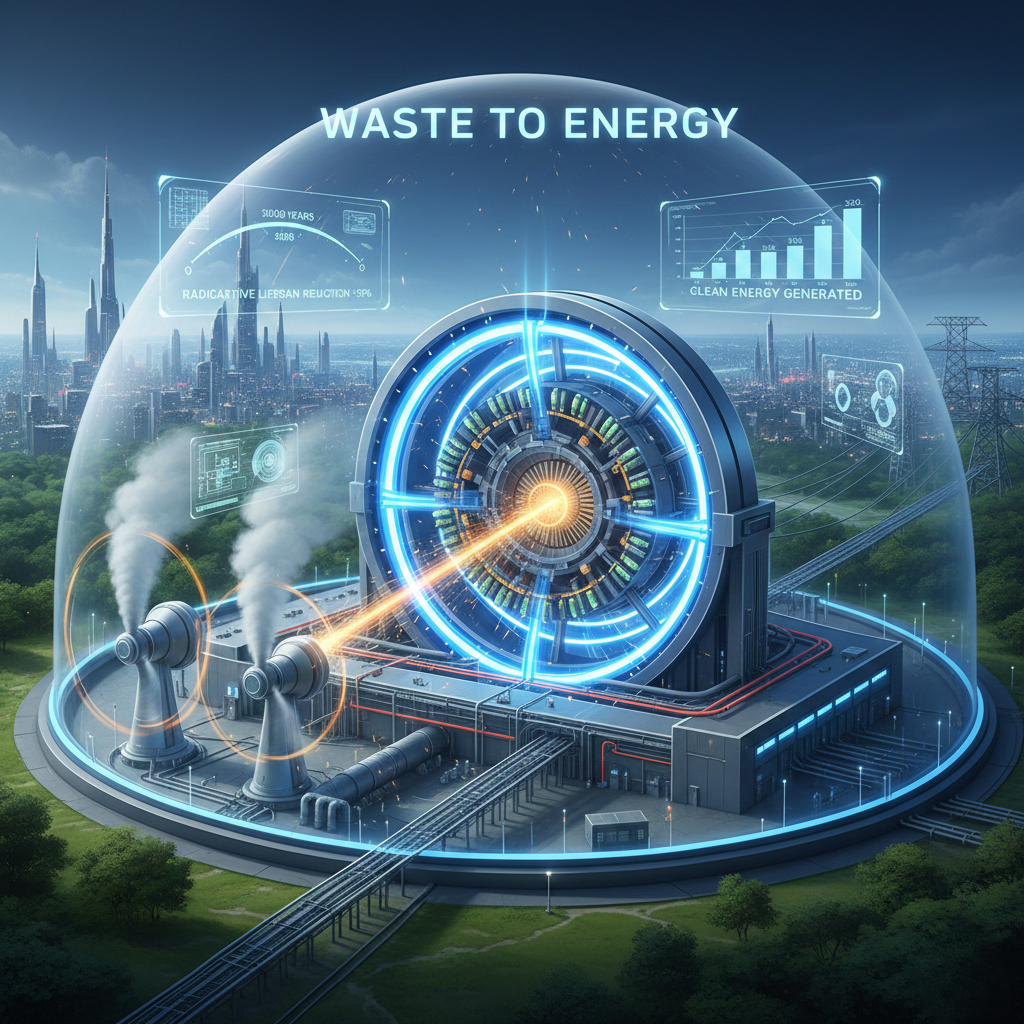
Researchers at the Thomas Jefferson National Accelerator Facility are developing a system that could turn spent nuclear fuel into clean electricity—while reducing its radioactive lifespan by more than 99%.
That’s a massive shift in how we think about nuclear waste.
The Big Idea: Treat Waste as Energy
Instead of storing spent fuel for thousands of years, this new approach treats it as reusable energy.
The method is based on something called accelerator-driven systems (ADS).
ADS uses powerful particle accelerators to trigger controlled nuclear reactions.
The goal is simple:
- Reduce long-lasting radioactive elements
- Generate usable heat
- Produce electricity for the power grid
It’s both waste reduction and energy production in one system.
How Accelerator-Driven Systems Work
The system uses high-energy particle beams.
These beams create a reaction known as spallation.
Here’s what happens:
- A particle beam hits a heavy metal target.
- This produces a large number of neutrons.
- Those neutrons strike long-lived radioactive materials.
- The materials transform into shorter-lived, safer elements.
This process removes the most hazardous parts of nuclear waste.
Storage time could drop from about 100,000 years to roughly 300 years.
That’s a dramatic improvement.
Producing Electricity at the Same Time
While breaking down radioactive materials, ADS also produces intense heat.
That heat can:
- Boil water
- Spin turbines
- Generate electricity
In other words, the system doesn’t just reduce waste.
It creates carbon-free energy.
Why This Matters for Clean Energy
Nuclear power is already a low-carbon energy source.
But long-term waste storage has slowed wider adoption.
If ADS technology works at scale, it could:
- Reduce the need for deep geological storage
- Lower long-term environmental risks
- Increase public confidence in nuclear energy
This could remove one of the biggest barriers to expanding carbon-free nuclear power.
Advanced Technology Behind the System
To make ADS practical and affordable, researchers are developing advanced components.
These include:
- Niobium-tin accelerator materials
- Modified magnetron systems (similar to those in microwave ovens)
- High-efficiency accelerator power systems
The work is supported by the U.S. Department of Energy through its NEWTON program.
Industry partnerships are also helping move the project closer to real-world deployment.
Can It Recycle All U.S. Nuclear Fuel?
The long-term goal is ambitious.
Researchers aim to recycle the entire U.S. commercial nuclear fuel supply within the next three decades.
If successful, nuclear waste could shift from being a storage burden to a valuable energy resource.
That would change the economics and perception of nuclear energy.
Real-World Comparison: Traditional Storage vs ADS
Traditional Nuclear Waste Storage
- Long-term containment (up to 100,000 years)
- No additional energy produced
- Ongoing monitoring required
Accelerator-Driven Systems
- Converts waste into usable fuel
- Cuts radioactive lifespan by over 99%
- Generates electricity during the process
The difference is huge.
Instead of burying the problem, the system uses it.
FAQs
What is an accelerator-driven system (ADS)?
It is a nuclear technology that uses particle accelerators to trigger reactions that reduce radioactive waste and generate energy.
How much can this reduce nuclear waste lifespan?
Researchers estimate the radioactive lifespan could drop from about 100,000 years to around 300 years.
Is this technology available now?
It is still under development, but testing and engineering progress are ongoing.
Does ADS produce electricity?
Yes. The heat generated during the process can be converted into electricity.
Who is funding the project?
The research is supported by the U.S. Department of Energy’s NEWTON program.
Final Thoughts
For decades, nuclear waste has been seen as a long-term problem with no easy solution.
Accelerator-driven systems offer a different vision.
Instead of storing dangerous materials for thousands of years, we could convert them into clean power and reduce their lifespan dramatically.
If this technology scales successfully, it could redefine nuclear energy—turning waste into one of the most valuable resources in the clean energy transition.
The future of carbon-free power may not just come from new fuel.
It may come from rethinking what we already have.
