

Close Menu
Innovate And ExploreInnovate And Explore

    Subscribe to Updates

    Get the latest creative news from FooBar about art, design and business.

    What's Hot

    How to Grow Instagram from 0 to 10K Followers in 2026 Using Organic Methods

    May 22, 2026

    Smart Wearables Are Reshaping the Future of Everyday Technology

    May 13, 2026

    Everyday Tech How-To Guides for a Smarter and Easier Digital Life

    May 13, 2026
    Facebook Instagram
    Facebook Instagram YouTube TikTok
    Innovate And ExploreInnovate And Explore
    • Artificial Intelligence
    • Medical Research
    • Technology News
    • Science News
    • VR Headset
    • Palantir
    Innovate And ExploreInnovate And Explore
    Home » New Online Tool Lets You See Where Your House Was 320 Million Years Ago
    New Technology

    New Online Tool Lets You See Where Your House Was 320 Million Years Ago

    alfredBy alfredApril 30, 2026No Comments4 Mins Read
    Facebook Twitter Pinterest LinkedIn Tumblr WhatsApp Email
    Share
    Facebook Twitter LinkedIn WhatsApp Pinterest Email

    Introduction

    Ever wondered where your home existed millions of years ago? It might sound strange. However, thanks to modern science, you can now explore Earth’s deep past in seconds.

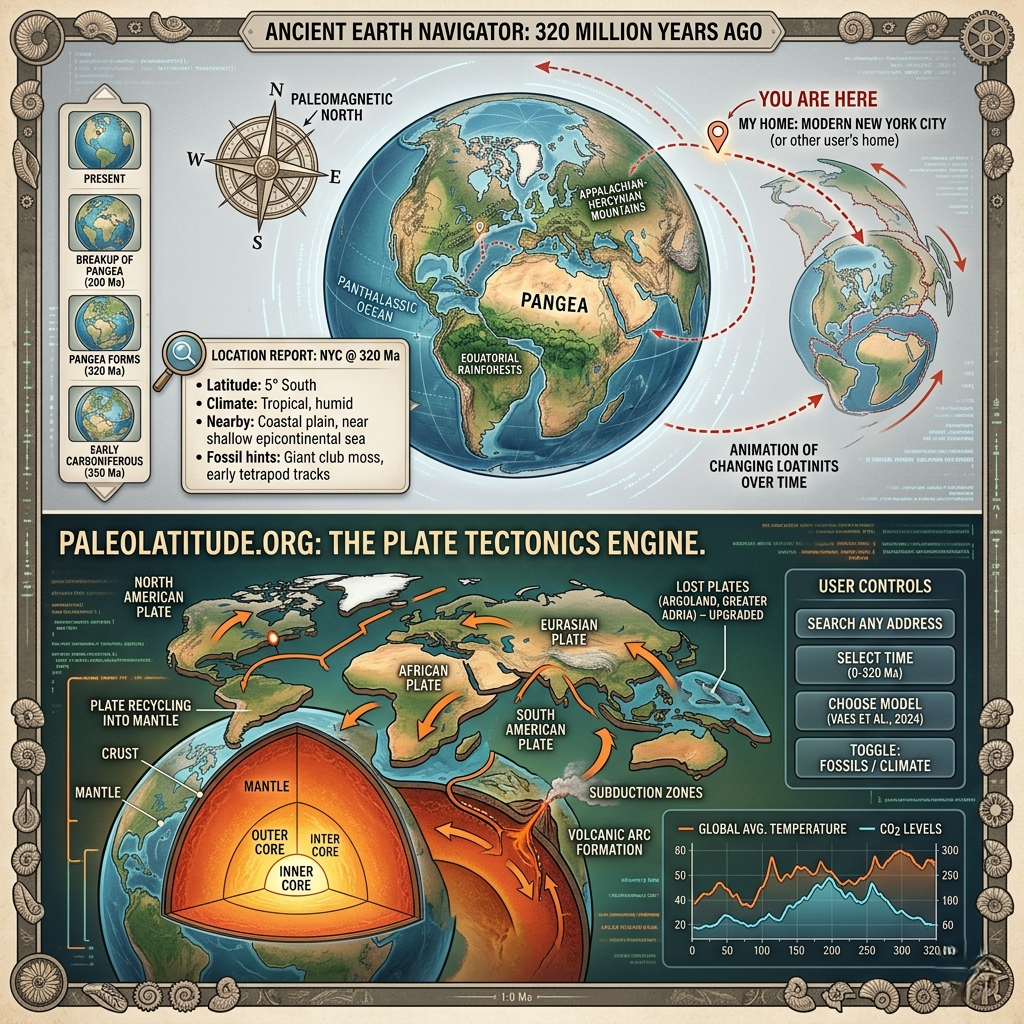
    A new online tool lets you see exactly where your current location sat 320 million years ago. Even more exciting, it shows how continents have shifted over time.

    What Is This Tool and How Does It Work?

    The tool, called Ancient Earth Globe, uses scientific data based on plate tectonics. It recreates Earth’s past positions with surprising accuracy.

    In simple terms, it tracks how continents moved over millions of years. Then, it maps your current location onto those ancient positions.

    Here’s how it works:

    1. You enter your city or address
    2. The tool identifies your coordinates
    3. It rewinds Earth’s movement
    4. You see your location in the ancient world

    As a result, you get a visual journey back in time.

    What Did Earth Look Like 320 Million Years Ago?

    Around 320 million years ago, Earth looked completely different. During this period, known as the Carboniferous era, continents were merging into a supercontinent.

    This massive landmass is known as Pangaea.

    Key differences back then:

    • Continents were joined together
    • Tropical forests covered large areas
    • Oxygen levels were much higher
    • Giant insects and early reptiles existed

    So, your home might have been near the equator or even underwater.

    Why This Tool Is So Interesting

    This tool isn’t just fun. It also helps people understand Earth’s history in a simple way.

    Here’s why people love it:

    • It makes science interactive
    • It shows real geological movement
    • It connects personal locations with history
    • It’s easy to use for anyone

    Moreover, it turns complex science into something visual and engaging.

    Real Example: What You Might Discover

    Let’s say you live in Karachi.

    Today, it’s part of South Asia. However, 320 million years ago, that land could have been located much closer to the southern hemisphere.

    Because of continental drift, land has moved thousands of kilometers over time. As a result, your “home” has traveled across the planet without you noticing.

    The Science Behind It (Simple Explanation)

    This tool is based on the theory of plate tectonics.

    Earth’s surface is divided into plates. These plates slowly move over millions of years.

    Key points:

    • Plates shift a few centimeters per year
    • Over millions of years, this creates huge changes
    • Continents split, merge, and drift

    Therefore, your current location wasn’t always where it is today.

    How You Can Use This Tool

    Using this tool is very simple.

    Quick steps:

    • Open the Ancient Earth Globe website
    • Type your location
    • Select a time period (like 320 million years ago)
    • Explore the map

    You can also try different time periods to see how your location changed over time.

    Common Questions

    Is the tool accurate?

    It uses real scientific data. However, exact positions may vary slightly due to limitations in ancient mapping.

    Can I check other time periods?

    Yes, you can explore different eras, not just 320 million years ago.

    Is it free to use?

    Yes, the tool is completely free and accessible online.

    Why This Matters

    At first, this might feel like just a fun experiment. However, it actually shows how dynamic our planet is.

    It reminds us that Earth is always changing. Moreover, it helps us understand geology, climate shifts, and evolution in a more relatable way.

    Conclusion

    This tool turns millions of years of Earth’s history into a simple, interactive experience. Instead of just reading about it, you can actually see it.

    👉 Try it yourself and discover where your home was 320 million years ago. You might be surprised it could have been part of a jungle, ocean, or even a different continent entirely.

    advanced encryption standard ai chatgpt ai science news artificial general intelligence california science center hologram museum medical research palantir quantum physics science center science fair board science museum scientific method tech news virtual reality headset
    Share. Facebook Twitter Pinterest LinkedIn Tumblr WhatsApp Email
    alfred

    Related Posts

    How to Grow Instagram from 0 to 10K Followers in 2026 Using Organic Methods

    May 22, 2026

    Smart Wearables Are Reshaping the Future of Everyday Technology

    May 13, 2026

    Everyday Tech How-To Guides for a Smarter and Easier Digital Life

    May 13, 2026

    The Rise of AI Girlfriends and Virtual Companions: Future or Danger?

    May 10, 2026

    The Dark Side of Deepfake Technology in 2026

    May 9, 2026

    How AI Video Generators Are Replacing Traditional Content Creation

    May 9, 2026
    Add A Comment
    Leave A Reply Cancel Reply

    Don't Miss

    How to Grow Instagram from 0 to 10K Followers in 2026 Using Organic Methods

    By alfredMay 22, 2026

    Introduction Starting from zero on Instagram feels tough at first. However, with the right strategy,…

    Smart Wearables Are Reshaping the Future of Everyday Technology

    May 13, 2026

    Everyday Tech How-To Guides for a Smarter and Easier Digital Life

    May 13, 2026

    The Rise of AI Girlfriends and Virtual Companions: Future or Danger?

    May 10, 2026
    Stay In Touch
    • Facebook
    • Twitter
    • Pinterest
    • Instagram
    • YouTube
    • Vimeo
    Our Picks

    How to Grow Instagram from 0 to 10K Followers in 2026 Using Organic Methods

    May 22, 2026

    Smart Wearables Are Reshaping the Future of Everyday Technology

    May 13, 2026

    Everyday Tech How-To Guides for a Smarter and Easier Digital Life

    May 13, 2026

    The Rise of AI Girlfriends and Virtual Companions: Future or Danger?

    May 10, 2026

    Subscribe to Updates

    Get the latest creative news from SmartMag about art & design.

    Techlo Inno
    Innovate And Explore
    Facebook Instagram YouTube TikTok
    • About Us
    • Cookies Policy
    • Editorial Policy
    • Terms & Conditions
    © 2026 Innovate and Explore. Designed by Techlo Inno.

    Type above and press Enter to search. Press Esc to cancel.

    Powered by
    ►
    Necessary cookies enable essential site features like secure log-ins and consent preference adjustments. They do not store personal data.
    None
    ►
    Functional cookies support features like content sharing on social media, collecting feedback, and enabling third-party tools.
    None
    ►
    Analytical cookies track visitor interactions, providing insights on metrics like visitor count, bounce rate, and traffic sources.
    None
    ►
    Advertisement cookies deliver personalized ads based on your previous visits and analyze the effectiveness of ad campaigns.
    None
    ►
    Unclassified cookies are cookies that we are in the process of classifying, together with the providers of individual cookies.
    None
    Powered by