


Introduction: When Electricity Met Personal Hygiene
Inventors often test strange ideas. However, few explored them as boldly as Nikola Tesla.
Tesla experimented with electricity not only for machines but also for power systems. Surprisingly, he also tested it on himself.
One of his most curious demonstrations involved something he called “cold fire.”
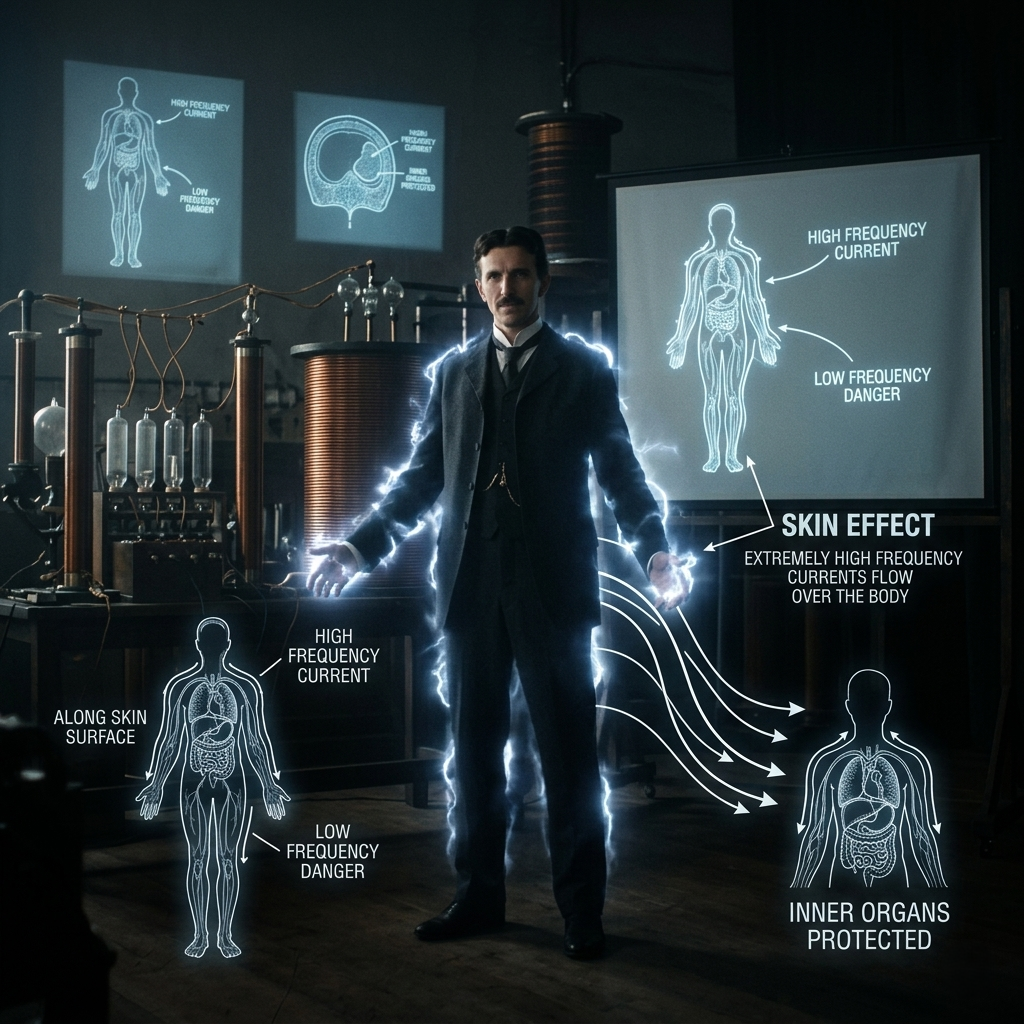
During these experiments, Tesla exposed his body to high-frequency electrical currents. As a result, a glowing layer of electricity appeared around his skin.
Even more interesting, Tesla believed this electrical effect might help clean the body.
Although the idea never replaced normal bathing, the experiment shows just how far Tesla’s imagination went.
What Tesla Meant by “Cold Fire”
The phrase “cold fire” sounds mysterious. However, the science behind it relates to high-frequency electricity.
Tesla used specialized electrical equipment to generate extremely fast alternating currents. When these currents surrounded the human body, they produced a glowing electrical field.
Because the frequency was very high, the electricity flowed mostly around the surface rather than deeply through the body.
As a result, the sensation felt different from normal electric shock.
Instead of heat or pain, observers often saw:
- A faint glow around the body
- Small sparks of electricity
- A soft buzzing or crackling effect
Therefore, Tesla described the phenomenon as fire without heat, or “cold fire.”
How the Demonstration Worked
Tesla performed these demonstrations during lectures and laboratory experiments.
He used devices called Tesla coils, which produced extremely high voltages at very high frequencies.
These machines allowed electricity to move around objects instead of passing directly through them.
During a typical demonstration:
- Tesla generated high-frequency electrical currents using his equipment.
- The electrical energy created a surrounding electromagnetic field.
- Sparks and glowing effects appeared around his body.
Because the current behaved differently at high frequencies, it produced a dramatic visual effect.
This glowing field fascinated audiences and scientists alike.
The Science Behind the Experiment
Tesla’s idea came from his deep knowledge of electromagnetism.
High-frequency electricity behaves differently from the electricity used in homes.
Instead of penetrating deeply into materials, the current tends to travel along surfaces. Scientists often call this behavior the skin effect.
Because of this property, Tesla believed carefully controlled electrical energy might interact safely with the human body.
Furthermore, he thought this interaction might offer practical benefits.
Tesla’s Hygiene Theory
Tesla believed that electricity might help remove dust or microorganisms from the skin.
His theory suggested that electrical energy could:
- Dislodge tiny particles from the body
- Neutralize certain microbes
- Provide a form of dry, electrical cleansing
In other words, Tesla imagined a future where people could use electrical energy instead of water for hygiene.
While this idea sounds futuristic, it reflected Tesla’s habit of applying physics to everyday life.
Why the Idea Never Became Common
Despite the fascinating concept, electrical bathing never became a practical hygiene method.
Several factors prevented its adoption.
1. Safety Concerns
Electricity can be dangerous without strict control. Therefore, widespread electrical bathing would carry risks.
2. Limited Scientific Evidence
Tesla’s demonstrations were impressive. However, scientists lacked strong proof that the method effectively removed bacteria.
3. Simpler Alternatives
Traditional bathing remained safer, cheaper, and easier for everyday use.
Consequently, Tesla’s “cold fire” remained more of a scientific curiosity than a real hygiene solution.
Tesla’s Legacy of Bold Experiments
Although the hygiene idea never took off, the experiment still reflects Tesla’s remarkable creativity.
Tesla constantly explored unusual applications of electricity.
His work contributed to several important technologies, including:
- Wireless energy experiments
- Radio and communication research
- High-voltage electrical engineering
- Advanced electromagnetic systems
Today, scientists and historians still study his demonstrations.
They reveal how one inventor pushed the boundaries of imagination and physics.
Why Tesla’s Experiments Still Matter Today
Modern technology still builds on many of Tesla’s electrical discoveries.
For example, research into electromagnetic fields now influences fields such as the following:
- Medical imaging
- Plasma technology
- Wireless power transfer
- Biomedical devices
Although Tesla’s electrical bathing idea never became mainstream, it reflects the spirit of innovation that drives science forward.
Sometimes bold experiments inspire discoveries in unexpected ways.
FAQs
What was Nikola Tesla’s “cold fire” experiment?
Tesla exposed his body to high-frequency electrical currents, creating a glowing electrical field around his skin. He believed this phenomenon might help remove dust and bacteria.
Was the cold fire experiment dangerous?
Tesla carefully controlled the electrical currents during demonstrations. However, uncontrolled high-voltage electricity can be extremely dangerous.
Did Tesla really think electricity could replace bathing?
Yes, Tesla believed electrical energy might provide a new form of hygiene by removing particles or microbes from the skin.
Did the cold fire idea work?
There is no strong scientific evidence that it worked as a hygiene method. Therefore, it never replaced traditional bathing.
Why do people still talk about Tesla’s experiments?
Tesla’s demonstrations showed his creativity and deep understanding of electrical science. They also helped inspire later research into electromagnetic technologies.
Final Thoughts
The Nikola Tesla cold-fire experiment remains one of the most unusual moments in scientific history.
By surrounding himself with high-frequency electricity, Tesla demonstrated both the beauty and mystery of electromagnetic energy.
Although the idea of electrical hygiene never became reality, the experiment highlights Tesla’s fearless curiosity.
More importantly, it reminds us that innovation often begins with bold and unconventional thinking.
