


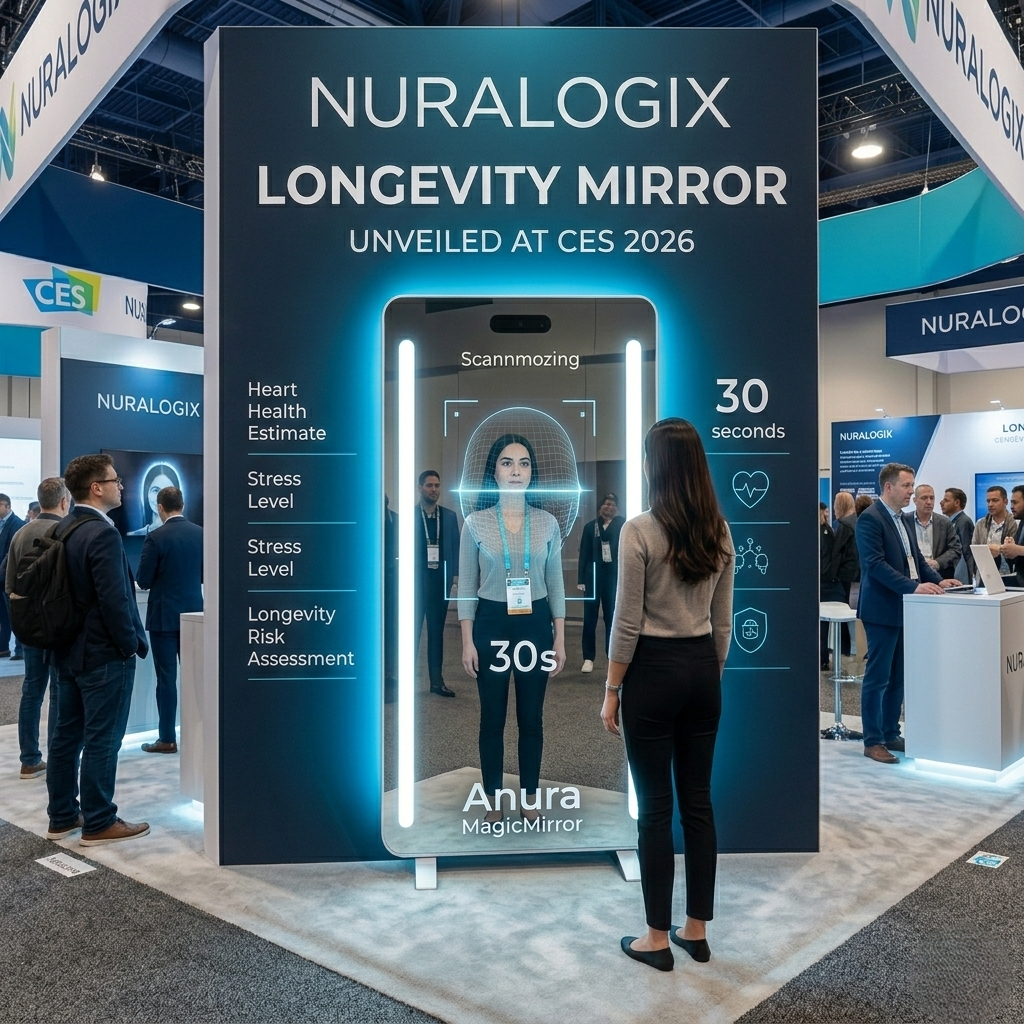
What if your bathroom mirror could tell you how healthy you are—in just 30 seconds?
At CES 2026, Canadian health-tech company NuraLogix introduced the Longevity Mirror, a smart mirror that gives you a quick health snapshot using only a selfie.
- No wearables. No needles. No clinic visit.
- Just stand in front of the mirror and let it scan your face.
What Is the Longevity Mirror?
The Longevity Mirror is a smart health device powered by AI.
It scans your face for 30 seconds and analyzes tiny changes in blood flow. Then it generates a health report and a “Longevity Index” score.
- This score ranges from 0 to 100 and reflects your overall wellness.
- It’s designed as a wellness tool—not a medical diagnosis device.
How Does It Work?
Transdermal Optical Imaging (TOI) Technology
The mirror uses something called Transdermal Optical Imaging (TOI).
TOI tracks subtle color changes in your facial skin caused by blood circulation. These changes are invisible to the human eye.
But AI can detect them.
From that data, the system estimates:
- Heart rate
- Blood pressure
- Stress levels
- Metabolic indicators
- Cardiovascular health
It’s similar to how some smartphone apps detect heart rate through a camera—but far more advanced.
What Is the Longevity Index Score?
After your scan, the mirror generates a Longevity Index score between 0 and 100.
- This number reflects your general wellness based on multiple health signals.
- Higher scores = better overall health markers.
- According to NuraLogix, its AI models were trained on hundreds of thousands of patient records.
- The company claims the system can project possible health risks up to 20 years ahead.
However, it clearly states this is not a replacement for medical diagnosis.
Built-In AI Health Assistant
The mirror doesn’t just show numbers.
It includes an AI health assistant that explains your results in simple language.
You also get personalized suggestions, such as
- Sleep improvement tips
- Nutrition guidance
- Stress reduction advice
- Exercise recommendations
This makes the experience feel more like having a digital health coach at home.
Designed for Families
- The Longevity Mirror supports up to six user profiles.
- That means couples or families can use the same device while keeping their data separate.
- It’s built for shared spaces like bedrooms or bathrooms.
Pricing and Subscription Model
The Longevity Mirror is expected to launch in early 2026.
Here’s the pricing breakdown:
- Device price: $899 (includes one-year subscription)
- After first year: $99 per year
- Optional concierge-level service: starts at $399 per year
The concierge service likely includes more detailed health insights and personalized guidance.
Real-World Comparison: Mirror vs Wearables
Most people track health using smartwatches.
Devices like fitness trackers monitor heart rate throughout the day.
But the Longevity Mirror works differently.
Wearables:
- Continuous tracking
- Must be worn daily
- Focus mostly on activity and heart rate
Longevity Mirror:
- 30-second scan
- No device attached to body
- Focus on broader health indicators
It’s less about daily steps and more about long-term health trends.
Is It Reliable?
That’s the big question.
- AI health tools are improving fast, but they’re still not medical-grade replacements.
- Since the mirror relies on facial blood flow patterns, lighting and positioning may affect results.
- And while AI trained on large datasets sounds impressive, real-world accuracy will matter most.
Users should treat it as a wellness guide—not a medical decision-maker.
Who Is It For?
The Longevity Mirror may appeal to:
- Health-conscious individuals
- Biohackers and longevity enthusiasts
- Families tracking shared wellness
- People who dislike wearing smart devices
It’s especially attractive for those interested in preventive health.
Potential Impact on the Health-Tech Industry
Smart mirrors have existed before.
But combining AI, TOI technology, and long-term risk projection pushes this into new territory.
If accurate, this could change how people monitor early health signals at home.
It also shows how AI is moving from phones and watches into everyday objects.
FAQs
Is the Longevity Mirror a medical device?
No. It is marketed as a wellness tool, not a diagnostic medical device.
Always consult a doctor for medical concerns.
How long does the scan take?
The scan takes about 30 seconds.
You simply look into the mirror while it analyzes your facial blood flow.
Can it detect serious diseases?
It estimates risk factors related to cardiovascular and metabolic health.
It does not directly diagnose diseases.
Do I need a subscription?
Yes. The device includes one year of subscription.
After that, it costs $99 per year for continued access.
Is my data secure?
While full details depend on company policies, users should always review privacy terms before sharing health data.
Final Thoughts
The NuraLogix Longevity Mirror is one of the most interesting health-tech devices shown at CES 2026.
It blends AI, facial imaging, and predictive modeling into a simple home device.
The idea is powerful: check your health in 30 seconds without wearing anything.
Still, real-world accuracy and long-term reliability will decide its success.
If it delivers on its promises, this could be a big step toward smarter preventive healthcare at home.
Would you trust a mirror to tell you about your future health?
