

Close Menu
Innovate And ExploreInnovate And Explore

    Subscribe to Updates

    Get the latest creative news from FooBar about art, design and business.

    What's Hot

    How to Grow Instagram from 0 to 10K Followers in 2026 Using Organic Methods

    May 22, 2026

    Smart Wearables Are Reshaping the Future of Everyday Technology

    May 13, 2026

    Everyday Tech How-To Guides for a Smarter and Easier Digital Life

    May 13, 2026
    Facebook Instagram
    Facebook Instagram YouTube TikTok
    Innovate And ExploreInnovate And Explore
    • Artificial Intelligence
    • Medical Research
    • Technology News
    • Science News
    • VR Headset
    • Palantir
    Innovate And ExploreInnovate And Explore
    Home » Quantum Breakthrough: Schrödinger’s Cat Survives 23 Minutes
    Science Experiments

    Quantum Breakthrough: Schrödinger’s Cat Survives 23 Minutes

    alfredBy alfredMay 2, 2026No Comments3 Mins Read
    Facebook Twitter Pinterest LinkedIn Tumblr WhatsApp Email
    Share
    Facebook Twitter LinkedIn WhatsApp Pinterest Email

    Introduction

    Imagine something being in two states at once and staying that way for minutes. Sounds unreal, right?

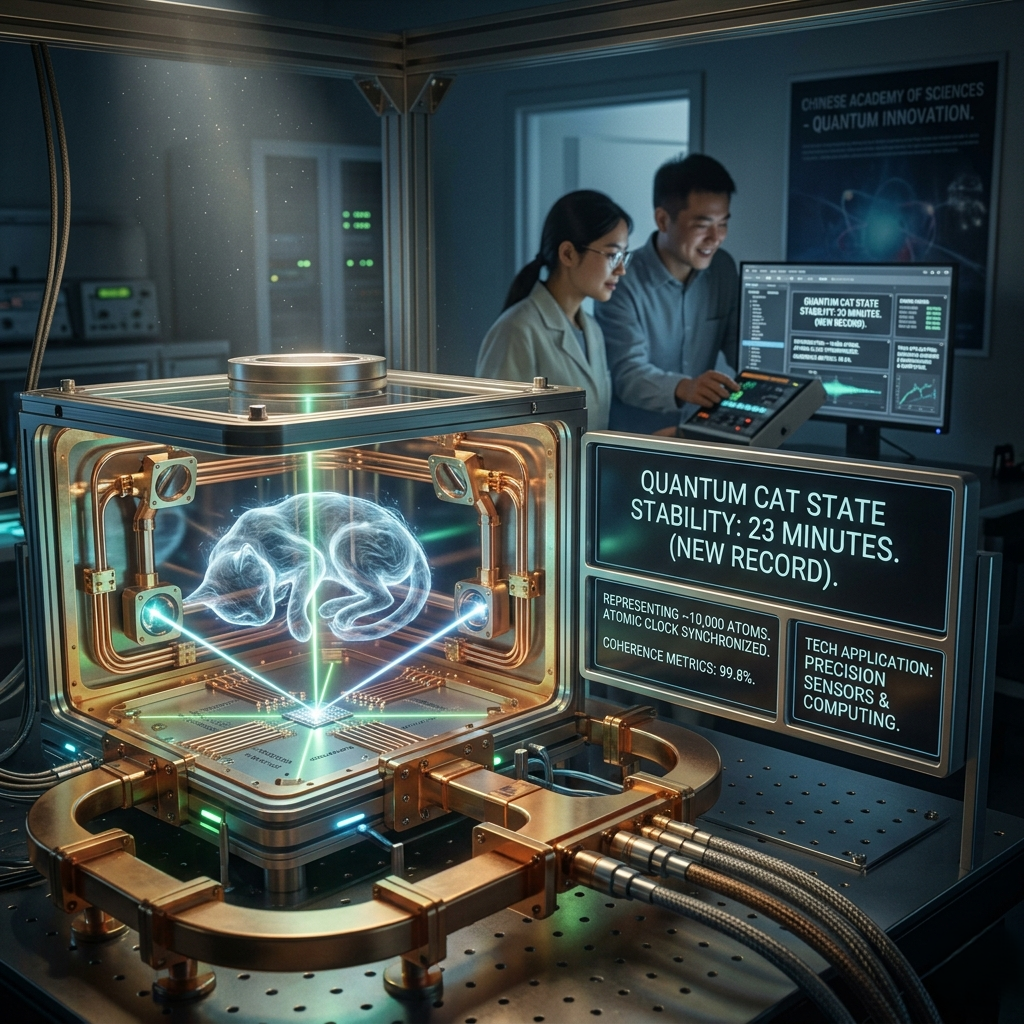
    Now, scientists in China have done exactly that. They kept a quantum “Schrödinger’s cat” state alive for nearly 23 minutes, breaking all previous records.

    This isn’t just impressive. Instead, it could change how we measure time, detect signals, and even understand the universe itself.

    What Is a Schrödinger’s Cat State?

    The idea comes from Erwin Schrödinger, who described a famous thought experiment.

    In simple terms, a system can exist in two states at once. For example, something can be both “on” and “off” until it is measured.

    Why It Matters

    • It shows how strange quantum physics can be
    • It helps scientists study superposition
    • It plays a key role in quantum technologies

    However, these states are extremely fragile. They usually collapse almost instantly.

    Record-Breaking Experiment in China

    Researchers at the University of Science and Technology of China achieved something remarkable.

    They maintained a quantum superposition for 1,400 seconds, almost 23 minutes.

    How They Did It

    First, they cooled about 10,000 atoms of ytterbium-173 to near absolute zero.

    Then, they trapped these atoms using lasers. As a result, the atoms stayed stable in two spin states at the same time.

    Key Technologies Used

    • Decoherence-free subspace: Protected the system from noise
    • Magic wavelength optical lattice: Stabilized the atoms
    • Ultra-cold environment: Reduced interference

    Because of these methods, the system stayed stable far longer than expected.

    Why This Breakthrough Is Important

    This achievement is not just about time. Instead, it opens new doors in science and technology.

    Major Benefits

    1. Ultra-Precise Measurements
    These quantum states are extremely sensitive. Therefore, they can detect tiny changes in magnetic fields.

    2. Better Atomic Clocks
    More stable quantum states mean more accurate timekeeping.

    3. Advanced Navigation Systems
    Precise sensors can improve GPS-like systems, even without satellites.

    4. Testing Physics Theories
    Scientists can explore the limits of the Standard Model and search for unknown forces.

    Real-World Impact

    Although this sounds highly technical, the impact could be very practical.

    For example, better sensors could improve the following:

    • Medical imaging
    • Space exploration tools
    • Communication systems

    Moreover, industries that rely on precision could benefit the most.

    Why Quantum States Usually Fail Quickly

    Normally, quantum systems collapse due to environmental noise. Even tiny disturbances can destroy the superposition.

    However, in this experiment, scientists created what you can think of as a “quantum safe room.”

    As a result, the atoms stayed isolated and stable for much longer.

    What Comes Next?

    This record may not last forever. In fact, researchers believe even longer durations are possible.

    As vacuum and cooling technologies improve, quantum systems could become more reliable.

    Future Possibilities

    • Fault-tolerant quantum computing
    • Even more precise sensors
    • Deeper understanding of quantum reality

    Therefore, this is just the beginning.

    FAQs

    What is a quantum superposition?

    It is when a particle exists in multiple states at the same time until measured.

    Why is 23 minutes important?

    Because quantum states usually last only seconds or less. This is a huge improvement.

    What atoms were used?

    Scientists used ytterbium-173 atoms cooled to near absolute zero.

    Can this lead to quantum computers?

    Yes, longer-lasting states are essential for building stable quantum computers.

    Conclusion

    This breakthrough shows how far quantum science has come. Keeping a Schrödinger’s cat state alive for 23 minutes was once unthinkable.

    Now, it’s real, and it could reshape technology in ways we are just starting to understand.

    advanced encryption standard ai chatgpt ai science news artificial general intelligence california science center hologram museum medical research palantir quantum physics science center science fair board science museum scientific method tech news virtual reality headset
    Share. Facebook Twitter Pinterest LinkedIn Tumblr WhatsApp Email
    alfred

    Related Posts

    How to Grow Instagram from 0 to 10K Followers in 2026 Using Organic Methods

    May 22, 2026

    Smart Wearables Are Reshaping the Future of Everyday Technology

    May 13, 2026

    Everyday Tech How-To Guides for a Smarter and Easier Digital Life

    May 13, 2026

    The Rise of AI Girlfriends and Virtual Companions: Future or Danger?

    May 10, 2026

    The Dark Side of Deepfake Technology in 2026

    May 9, 2026

    How AI Video Generators Are Replacing Traditional Content Creation

    May 9, 2026
    Add A Comment
    Leave A Reply Cancel Reply

    Don't Miss

    How to Grow Instagram from 0 to 10K Followers in 2026 Using Organic Methods

    By alfredMay 22, 2026

    Introduction Starting from zero on Instagram feels tough at first. However, with the right strategy,…

    Smart Wearables Are Reshaping the Future of Everyday Technology

    May 13, 2026

    Everyday Tech How-To Guides for a Smarter and Easier Digital Life

    May 13, 2026

    The Rise of AI Girlfriends and Virtual Companions: Future or Danger?

    May 10, 2026
    Stay In Touch
    • Facebook
    • Twitter
    • Pinterest
    • Instagram
    • YouTube
    • Vimeo
    Our Picks

    How to Grow Instagram from 0 to 10K Followers in 2026 Using Organic Methods

    May 22, 2026

    Smart Wearables Are Reshaping the Future of Everyday Technology

    May 13, 2026

    Everyday Tech How-To Guides for a Smarter and Easier Digital Life

    May 13, 2026

    The Rise of AI Girlfriends and Virtual Companions: Future or Danger?

    May 10, 2026

    Subscribe to Updates

    Get the latest creative news from SmartMag about art & design.

    Techlo Inno
    Innovate And Explore
    Facebook Instagram YouTube TikTok
    • About Us
    • Cookies Policy
    • Editorial Policy
    • Terms & Conditions
    © 2026 Innovate and Explore. Designed by Techlo Inno.

    Type above and press Enter to search. Press Esc to cancel.

    Powered by
    ►
    Necessary cookies enable essential site features like secure log-ins and consent preference adjustments. They do not store personal data.
    None
    ►
    Functional cookies support features like content sharing on social media, collecting feedback, and enabling third-party tools.
    None
    ►
    Analytical cookies track visitor interactions, providing insights on metrics like visitor count, bounce rate, and traffic sources.
    None
    ►
    Advertisement cookies deliver personalized ads based on your previous visits and analyze the effectiveness of ad campaigns.
    None
    ►
    Unclassified cookies are cookies that we are in the process of classifying, together with the providers of individual cookies.
    None
    Powered by