

Introduction
Imagine solar panels that produce almost twice the energy you get today.
That’s no longer science fiction. It’s happening now.
Researchers from the National Renewable Energy Laboratory and the Fraunhofer Institute for Solar Energy Systems have achieved something remarkable.
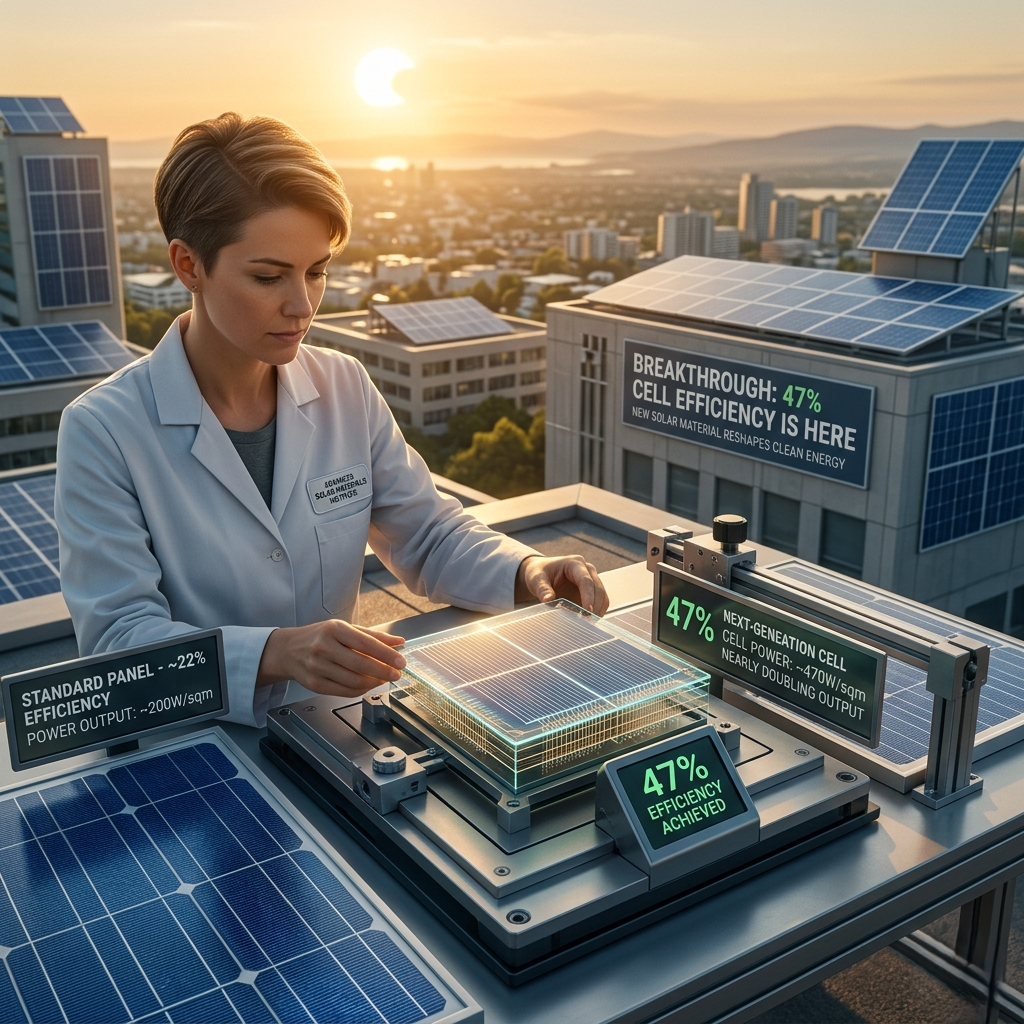
They’ve developed solar cells with over 47% efficiency.
In simple terms, that means capturing nearly half of the sun’s energy.
Why This Breakthrough Matters
Most solar panels you see today aren’t that efficient.
Typical Solar Panel Performance
- Standard silicon panels: 15%–25% efficiency
- New six-junction cells: Over 47% efficiency
So, this new technology almost doubles energy output.
As a result, it could transform how we produce clean electricity.
How These Solar Cells Work
These advanced cells use something called a six-junction design.
Instead of one layer, they stack multiple layers of materials.
Each layer captures a different part of sunlight.
Here’s the simple idea:
- Sunlight has many energy levels
- Regular panels waste a lot of it
- Multi-junction cells capture more of that energy
Because of this, they generate far more electricity.
The Power of Concentrated Sunlight
Another key innovation is light concentration.
These systems use lenses to focus sunlight over 140 times stronger than normal.
What does that do?
- Boosts energy input dramatically
- Improves overall efficiency
- Maximizes power output in small areas
However, this also means they need special setups, not typical rooftops.
Advanced Engineering Behind the Scenes
The real magic lies in semiconductor design.
These cells use inverted metamorphic structures, which help capture high-energy photons more effectively.
Why this matters:
- Reduces energy loss
- Improves electrical output
- Enhances long-term performance
So, while the concept sounds complex, the goal is simple:
👉 capture more sunlight, waste less energy
Where Are These Solar Cells Used Today?
Right now, these high-performance cells are not for everyday homes.
Instead, they are used in specialized environments like the following:
- Satellites in space
- Military and aerospace systems
- Concentrated photovoltaic (CPV) plants
Why only niche use?
- High production cost
- Complex installation
- Need for focused sunlight systems
Still, this is how many technologies begin expensive at first, then gradually become affordable.
Real-World Example: Space Applications
Satellites rely heavily on efficient solar power.
In space, every bit of energy matters.
That’s why multi-junction cells are already used there.
Because they generate more power in limited space, they are ideal for missions where efficiency is critical.
What This Means for the Future
This breakthrough opens exciting possibilities.
Potential Impact
- Smaller, more powerful solar systems
- Reduced land use for solar farms
- Higher energy output in sunny regions
- Faster transition to renewable energy
Over time, costs may drop.
When that happens, this technology could enter mainstream use.
Challenges Still Ahead
Despite the excitement, some hurdles remain.
Key Challenges
- High manufacturing costs
- Complex system design
- Limited scalability today
However, research continues to improve these areas.
So, progress is definitely moving forward.
FAQs
What makes these solar cells different?
They use multiple layers to capture more sunlight. This allows them to reach much higher efficiency than traditional panels.
Are 47% efficient solar panels available for homes?
Not yet. They are currently used in specialized systems due to high costs and technical requirements.
What is concentrated photovoltaic (CPV)?
It’s a system that uses lenses or mirrors to focus sunlight onto high-efficiency solar cells for better performance.
Will this technology become affordable?
Most likely, yes. As research advances and production scales up, costs usually decrease over time.
Final Thoughts
This innovation marks a major leap in solar technology.
Capturing nearly half of the sun’s energy once seemed impossible. Now, it’s a reality.
While these solar cells aren’t ready for rooftops yet, they show what’s possible.
