


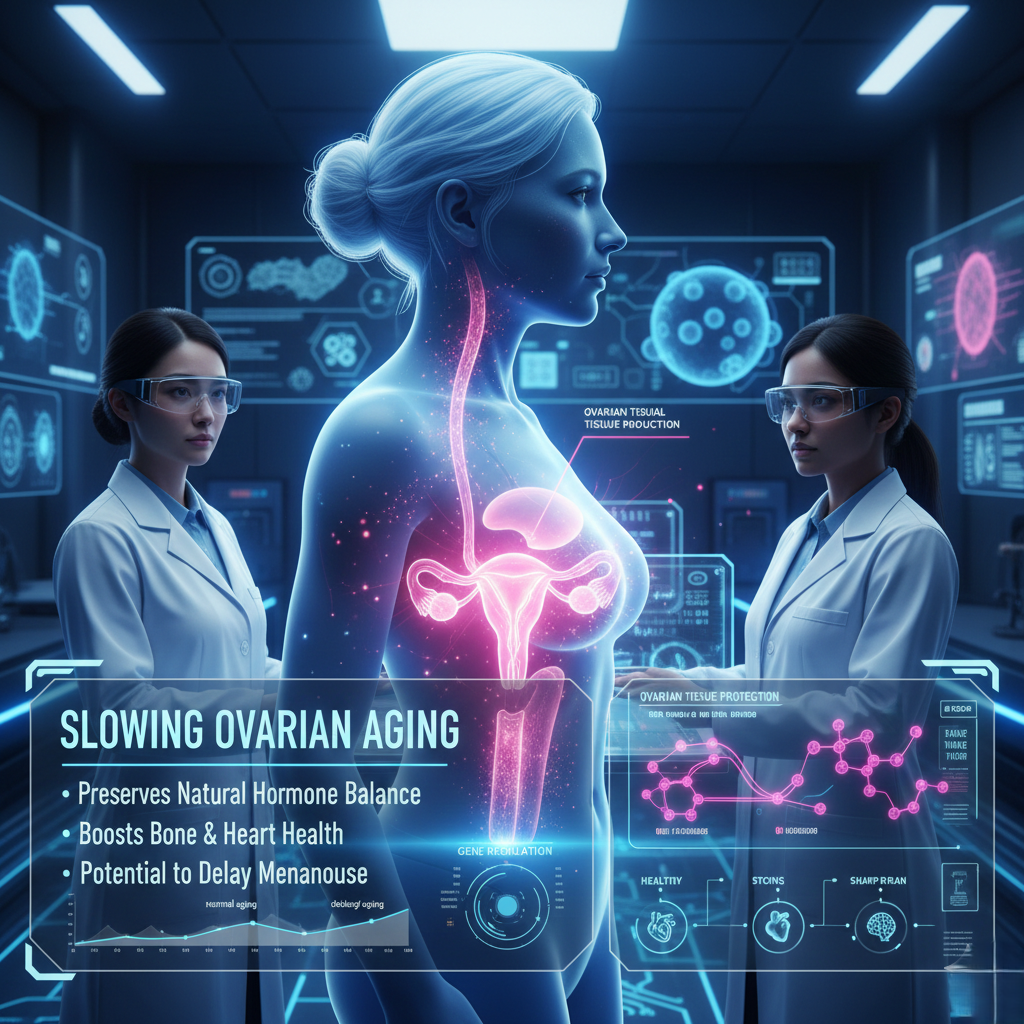
Menopause has long been considered a fixed biological milestone.
But groundbreaking new research suggests that ovarian aging may not be as irreversible as once believed.
Scientists have demonstrated that key mechanisms driving ovarian decline can be slowed and in some cases temporarily paused. This advance raises the possibility that menopause could one day be delayed, reshaping how we understand female aging and long-term health.
Why Ovarian Aging Matters Beyond Fertility
Ovarian aging affects far more than reproduction.
The ovaries play a central role in regulating hormones that influence the entire body.
As ovarian function declines, it impacts:
- Hormone balance
- Bone density
- Cardiovascular health
- Brain function
- Metabolic stability
Because of this, menopause is closely linked to multiple age-related health conditions.
Targeting Aging at the Source
Rather than treating symptoms after decline begins, researchers focused on protecting ovarian tissue itself.
What scientists discovered
By mapping molecular pathways involved in ovarian aging, researchers identified mechanisms that:
- Damage egg cells over time
- Disrupt surrounding ovarian tissue
- Reduce hormone production
They then developed targeted interventions to slow or interrupt these processes directly at the cellular level.
Ovarian Tissue Maintained Youthful Function
In experimental models, the results were striking.
Ovarian tissue exposed to protective strategies:
- Retained youthful activity far longer than expected
- Continued producing hormones past normal limits
- Preserved viable egg cells beyond typical aging timelines
These findings provide strong evidence that ovarian aging can be modified rather than simply endured.
A Fundamental Shift From Hormone Replacement Therapy
This approach differs sharply from conventional treatments.
How it’s different from HRT
Hormone replacement therapy works after ovarian decline has already occurred.
The new strategy focuses on maintaining the ovary’s natural self-regulation.
Potential advantages include:
- More stable, natural hormone balance
- Reduced reliance on external hormones
- Lower risk of side effects linked to hormone replacement
By preserving function rather than compensating for loss, the body remains in control.
Health Benefits That Extend Beyond Menopause
Slowing ovarian aging may offer protection against multiple age-related conditions.
Potential long-term benefits
Researchers suggest it could help reduce risks of:
- Osteoporosis
- Heart disease
- Cognitive decline
- Metabolic disorders
Because ovarian hormones influence nearly every organ system, preserving their natural production may support healthier aging overall.
What This Means for Longevity Research
The findings challenge long-held assumptions about aging.
Menopause has traditionally been viewed as:
- Inevitable
- Fixed
- Biologically irreversible
This research suggests that biological timelines may be more flexible than previously thought.
If ovarian aging can be delayed, scientists wonder what other aging processes might also be modifiable.
Important Limitations and Next Steps
Researchers stress caution.
- Most findings come from experimental models
- Extensive human trials are still required
- Long-term safety must be carefully evaluated
Despite this, the results represent a powerful proof of concept in reproductive science and aging research.
Frequently Asked Questions (FAQs)
Does this mean menopause can be avoided entirely?
No. The goal is to delay or slow the process, not eliminate it completely.
Is this available as a treatment yet?
Not yet. Human clinical trials are still needed before any therapies become available.
Could this extend fertility?
Potentially, but researchers emphasize broader health benefits beyond fertility alone.
Rethinking Aging: A New Biological Perspective
This discovery invites a profound shift in how we think about aging.
Rather than an unstoppable decline, aging may be a biological process that can be shaped, delayed, or refined.
While menopause will not disappear anytime soon, science is revealing that its timing and its impact may not be as fixed as once believed.
The future of aging research may lie not in replacing what’s lost, but in preserving what nature already designed.
