


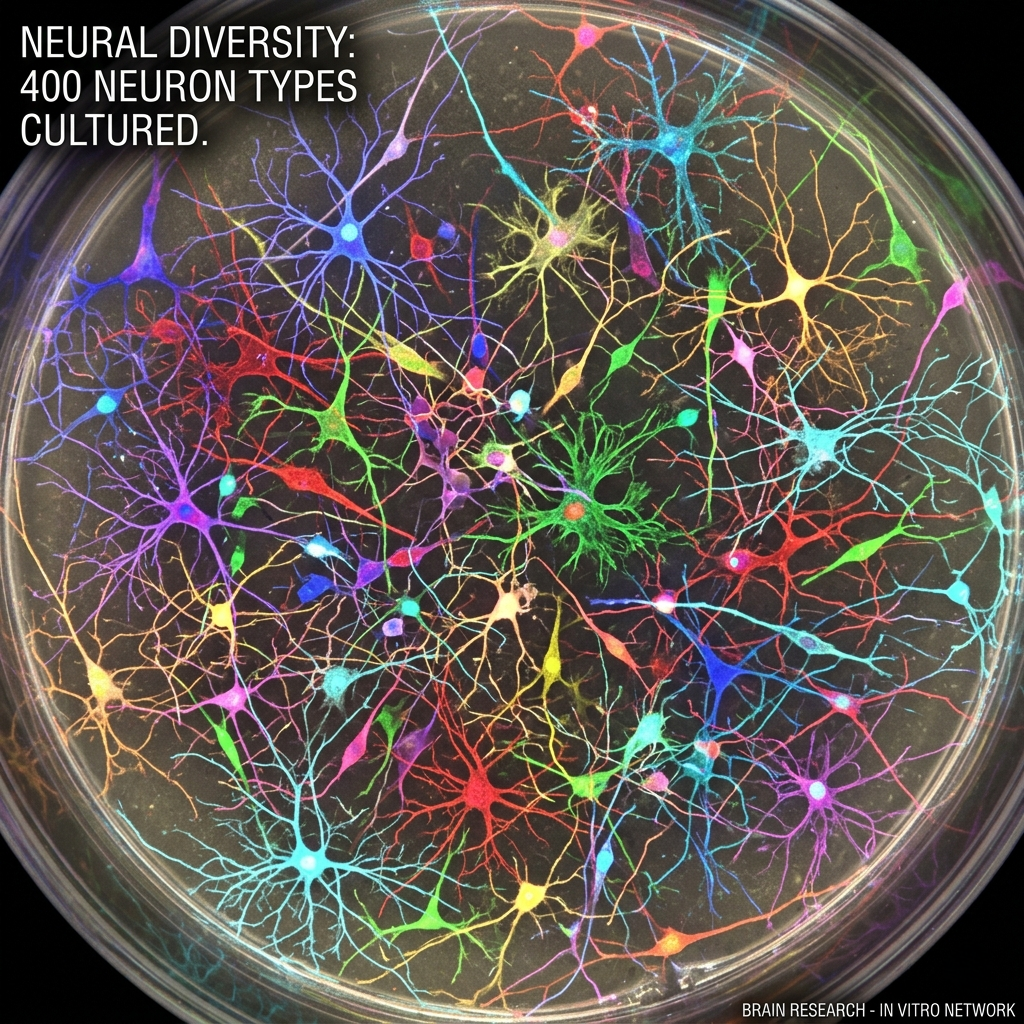
Understanding the human brain has always been difficult. It’s complex, delicate, and hard to study in real time.
Now, scientists have made a major breakthrough. They’ve successfully grown over 400 different types of neurons in the lab.
This could change how we study and treat serious brain diseases.
Why This Discovery Is So Important
The human brain contains many types of neurons. Each one has a unique role.
Until now, lab models didn’t fully reflect this diversity. As a result, research often missed key details.
With this new approach, scientists can recreate a more realistic brain environment.
What This Means
- More accurate disease studies
- Better understanding of brain function
- Faster progress in medical research
In short, this brings science much closer to real human biology.
What Are Neurons and Why Do They Matter?
Neurons are the building blocks of the brain. They send signals that control everything—from movement to memory.
Many brain diseases happen when these cells stop working properly.
Key Conditions Affected
- Alzheimer’s disease
- Parkinson’s disease
- Other neurodegenerative disorders
Because of this, studying neurons is essential for finding treatments.
How Scientists Achieved This
Researchers used advanced techniques to grow and organize neurons in the lab.
They recreated different neuron types and arranged them to behave like real brain cells.
Key Advancements
- Creation of 400+ neuron types
- Simulation of real brain circuits
- Controlled lab environment for testing
As a result, scientists can now observe how different neurons react to diseases.
How This Helps Fight Brain Diseases
This breakthrough opens new doors for treatment and research.
Major Benefits
- Better disease modeling—see how diseases develop step by step
- Drug testing – Test medicines safely and accurately
- Personalized treatments—Tailor therapies for different conditions
For example, researchers can now test how a drug affects specific neuron types linked to Alzheimer’s.
Real-World Impact
Millions of people worldwide suffer from brain disorders. However, progress has been slow due to limited tools.
Now, this new method changes that. It gives scientists a clearer view of what’s happening inside the brain.
Because of this, treatments could be developed faster and more effectively.
A Big Step Toward Understanding the Brain
The brain is often called the most complex organ in the body.
This breakthrough doesn’t solve everything. However, it brings us much closer to understanding how it works.
Step by step, science is unlocking its secrets.
FAQs
Why couldn’t scientists do this before?
Earlier models lacked neuron diversity, making it hard to study diseases accurately.
How does this help patients?
It speeds up research and improves the chances of finding effective treatments.
Can this cure Alzheimer’s or Parkinson’s?
Not yet, but it’s a major step toward better therapies.
Is this used in real treatments now?
It’s mainly for research, but it could lead to future medical breakthroughs.
Final Thoughts
Growing over 400 types of neurons in the lab is a huge leap for neuroscience. It improves research accuracy and opens new paths for treatment.
👉 As scientists continue exploring, this breakthrough could bring hope to millions affected by brain diseases worldwide.
