


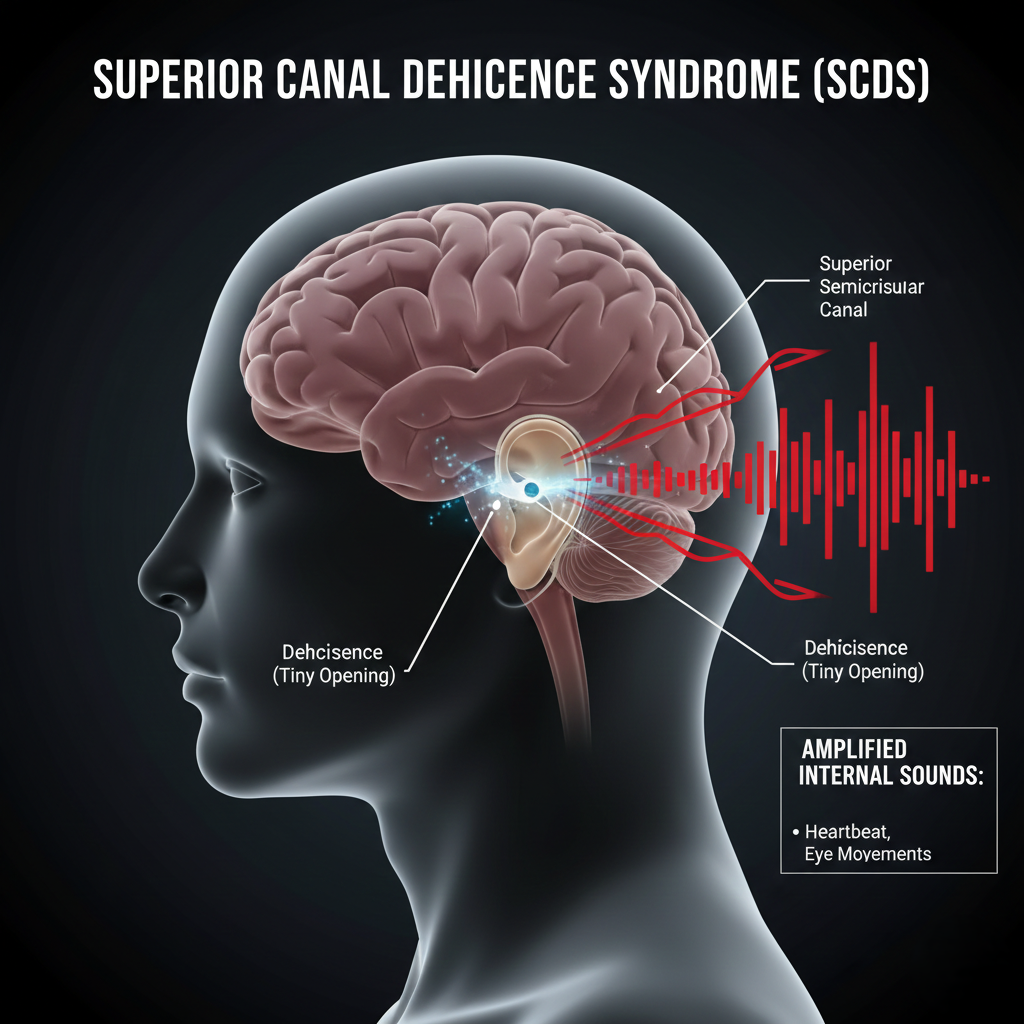
Imagine hearing your own heartbeat echo loudly inside your head.
Or even hearing your eyes move.
That’s the reality for some people living with Superior Canal Dehiscence Syndrome (SCDS)—a rare inner ear condition caused by a tiny opening in the bone that protects part of the balance canal.
Let’s break it down in a simple way.
What Is Superior Canal Dehiscence Syndrome?
Superior Canal Dehiscence Syndrome happens when a small hole forms in the thin bone covering the superior semicircular canal.
This canal is part of your inner ear and plays a key role in balance.
When the bone becomes too thin or develops an opening:
- Sound vibrations travel in unusual ways
- Pressure changes affect balance more strongly
- Internal body sounds become amplified
That tiny opening can make a big difference.
The Most Unusual Symptom: Autophony
One of the most surprising symptoms is called autophony.
This means hearing internal body sounds much louder than normal.
People with SCDS may hear:
- Their own heartbeat
- Footsteps echoing in their head
- Chewing or swallowing
- Even eye movements or blinking
It can feel strange, distracting, and sometimes distressing.
Other Common Symptoms
SCDS doesn’t only affect hearing.
It can also cause:
- Dizziness
- Balance problems
- Sensitivity to loud sounds
- Vertigo triggered by noise
- Discomfort from pressure changes
Simple actions like coughing, sneezing, or lifting something heavy may trigger symptoms.
Why Does SCDS Happen?
The exact cause isn’t always clear.
In many cases, the bone around the canal:
- Weakens over time
- Becomes unusually thin
- Slowly erodes
Some people may be born with thinner bone in that area.
Others develop symptoms later in life.
How Is SCDS Diagnosed?
Because symptoms can overlap with other ear conditions, proper evaluation is important.
Doctors usually rely on:
- Detailed symptom history
- Hearing tests
- Balance assessments
- High-resolution CT scans
An ear, nose, and throat (ENT) specialist can confirm the diagnosis.
Treatment Options
Not everyone with SCDS needs surgery.
Treatment depends on how severe symptoms are.
For mild cases:
- Monitoring may be enough
- Avoiding triggers can help
For more severe cases, doctors may recommend surgery to close the opening and restore normal inner ear function.
Many patients experience significant relief after surgical repair.
Real-Life Perspective
Imagine trying to focus at work while hearing your own breathing echo loudly inside your head.
Or feeling dizzy every time a door slams.
For people with SCDS, these are everyday challenges.
That’s why early diagnosis can make a big difference.
FAQs
Is superior canal dehiscence syndrome common?
No. It’s considered a rare inner ear condition.
Can SCDS go away on its own?
It usually does not resolve on its own. Symptoms may stay stable or gradually worsen.
Is surgery risky?
Like any procedure, surgery carries risks. However, many patients see strong improvement when performed by experienced specialists.
Can SCDS cause hearing loss?
It can cause unusual hearing symptoms, including sound distortion and sensitivity, but not always traditional hearing loss.
Final Thoughts
Superior Canal Dehiscence Syndrome may be rare, but its symptoms can feel overwhelming.
A tiny opening in the wrong place can change how the brain processes sound and balance.
If you or someone you know experiences unusual sound sensitivity or unexplained dizziness, consult a qualified ear specialist. Proper evaluation is key.
