


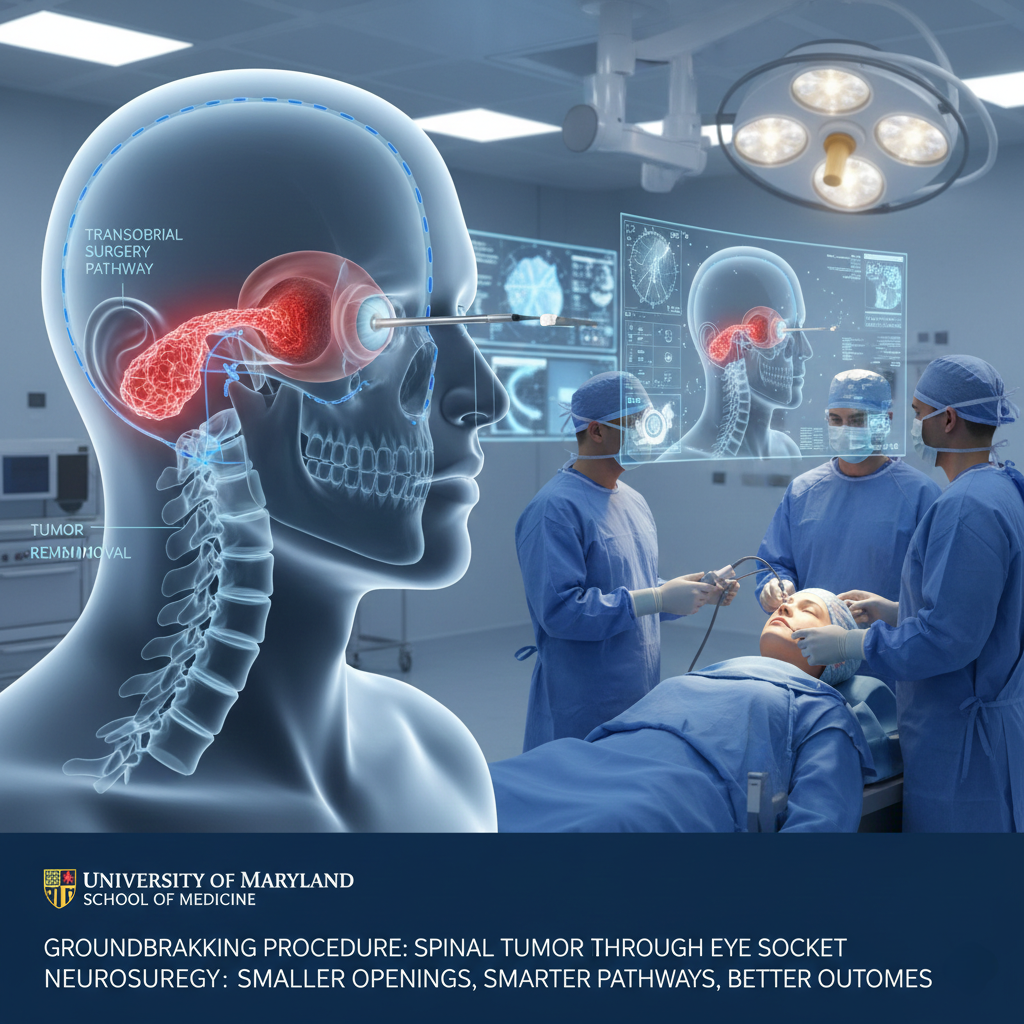
It sounds almost unbelievable.
Doctors removed a dangerous spinal tumor—through the patient’s eye socket.
This groundbreaking procedure was performed at the University of Maryland School of Medicine, marking a major step forward in minimally invasive neurosurgery.
Let’s look at how this works and why it matters.
What Is Transorbital Surgery?
The technique is called transorbital surgery.
“Transorbital” simply means going through the orbit—the natural opening of the eye socket.
Instead of:
- Opening large parts of the skull
- Making wide surgical cuts
- Moving significant brain tissue
Surgeons use a carefully planned path through the eye socket to reach deep areas near the upper spine and skull base.
This approach requires extreme precision and advanced imaging guidance.
Why Use the Eye Socket as an Entry Point?
The eye socket provides a natural corridor to certain deep areas of the skull and upper spine.
Using this route can:
- Reduce large incisions
- Minimize disruption to surrounding tissues
- Lower the risk of major complications
Traditional skull-base surgeries often involve significant bone removal and longer recovery times.
This method aims to avoid that.
Benefits of This Minimally Invasive Approach
Medical specialists highlight several potential advantages:
- Faster recovery
- Less post-surgical pain
- Reduced hospital stay
- Lower risk of infection
- Fewer complications
Because surgeons avoid opening large sections of the skull, trauma to the body is minimized.
For patients, that can make a huge difference.
How Modern Technology Makes This Possible
This kind of surgery would have been nearly impossible decades ago.
It relies on:
- High-resolution imaging
- 3D surgical navigation systems
- Advanced endoscopic tools
- Improved microsurgical techniques
These tools allow surgeons to operate in tight spaces with incredible accuracy.
Precision is everything in areas near the brain and spinal cord.
Why This Is a Milestone in Neurosurgery
Skull-base and upper spinal tumors are often difficult to reach.
They sit near:
- Critical nerves
- Major blood vessels
- Brain structures
In the past, these operations were considered extremely risky.
Minimally invasive skull-base procedures like this are reshaping how doctors approach complex tumors.
They expand treatment options for patients who might not tolerate traditional open surgery.
Real-World Impact for Patients
For someone diagnosed with a dangerous spinal tumor, surgery can feel overwhelming.
A less invasive option may mean:
- Shorter downtime
- Faster return to daily life
- Lower emotional stress
- Improved surgical outcomes
As techniques improve, more patients could benefit from safer approaches.
FAQs
1. Is transorbital surgery common?
It is still specialized and used in select cases. Not all tumors can be treated this way.
2. Does operating through the eye damage vision?
Surgeons carefully protect the eye and surrounding structures. In properly selected cases, vision can be preserved.
3. Is this safer than traditional surgery?
It can reduce certain risks, but every case depends on tumor size, location, and patient health.
4. Are all spinal tumors eligible for this method?
No. Only specific tumors near the skull base or upper spine may be accessible through this approach.
5. Is this the future of neurosurgery?
Minimally invasive techniques are growing worldwide and are expected to become more common.
Final Thoughts
Removing a spinal tumor through the eye socket may sound extreme.
But it reflects how far surgical science has come.
With better imaging, precision tools, and refined techniques, procedures once considered high-risk are becoming safer and more controlled.
This case from the University of Maryland School of Medicine highlights a clear trend:
Neurosurgery is moving toward smaller openings, smarter pathways, and better patient outcomes.
As technology continues to advance, minimally invasive approaches like transorbital surgery may redefine what’s possible in complex brain and spine care.
