

Close Menu
Innovate And ExploreInnovate And Explore

    Subscribe to Updates

    Get the latest creative news from FooBar about art, design and business.

    What's Hot

    China’s Photonic Quantum Chip Could Transform AI and Data Centers

    April 16, 2026

    Top Social Media Management Tools to Grow Faster in 2026

    April 16, 2026

    Biodegradable Fruit Wash Removes Pesticides and Keeps Fruit Fresh Longer

    April 15, 2026
    Facebook Instagram
    Facebook Instagram YouTube TikTok
    Innovate And ExploreInnovate And Explore
    • Artificial Intelligence
    • Medical Research
    • Technology News
    • Science News
    • VR Headset
    • Palantir
    Innovate And ExploreInnovate And Explore
    Home » Tesla FSD Handles Wildlife Safely: What It Means for Self-Driving Tech
    Artificial Intelligence

    Tesla FSD Handles Wildlife Safely: What It Means for Self-Driving Tech

    alfredBy alfredMarch 26, 2026No Comments3 Mins Read
    Facebook Twitter Pinterest LinkedIn Tumblr WhatsApp Email
    Share
    Facebook Twitter LinkedIn WhatsApp Pinterest Email

    Introduction: When AI Meets the Real World

    Driving isn’t just about roads and traffic lights. Sometimes, the biggest challenges are unexpected—like animals crossing the street.

    That’s where self-driving systems are truly tested. Recently, Tesla’s Full Self Driving (FSD) system showed a clear step forward.

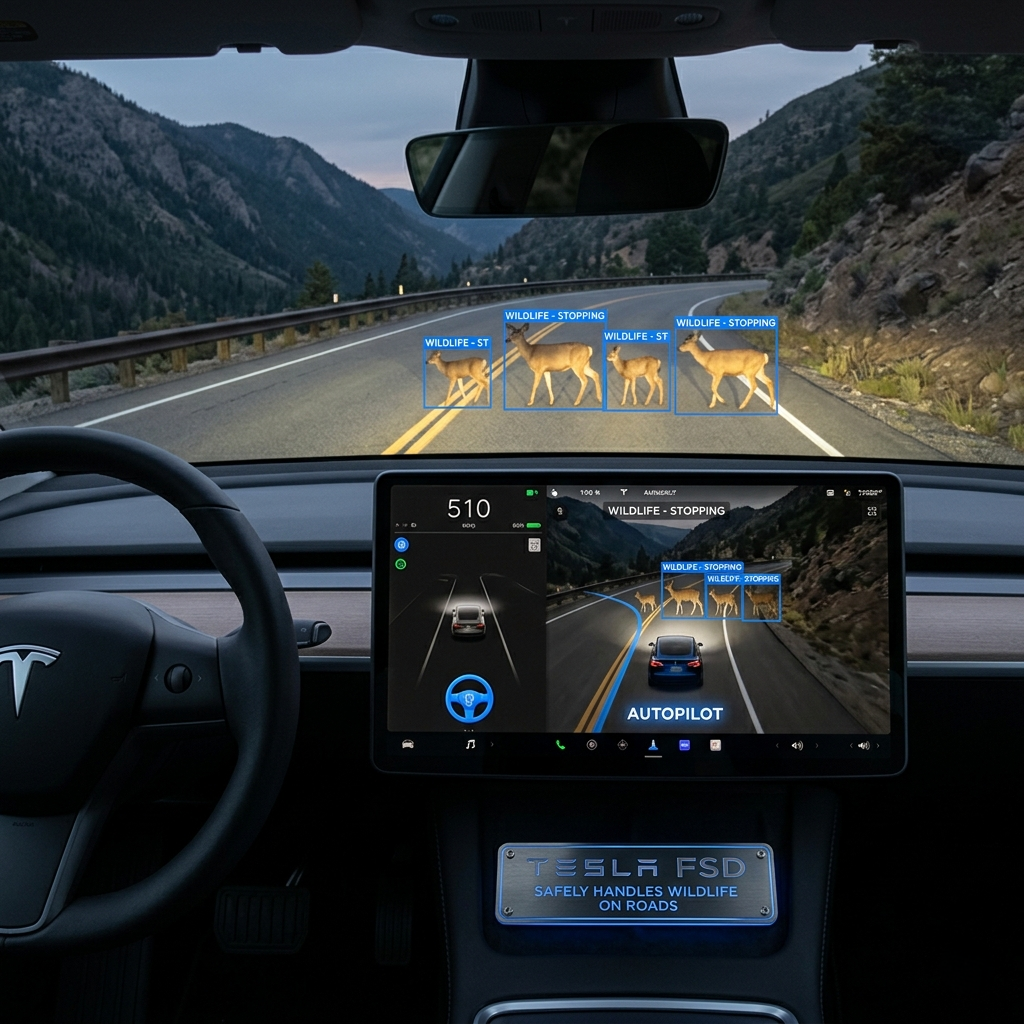
    In a real-world situation, the vehicle slowed down and stopped smoothly as a group of geese crossed the road.

    Simple moment—but a big signal of progress.

    What Happened in This Case?

    The situation was unpredictable. A group of geese suddenly entered the road.

    Instead of reacting abruptly, the Tesla vehicle handled it calmly.

    What the system did:

    • Detected the animals early
    • Gradually reduced speed
    • Came to a complete stop
    • Waited until the road was clear

    As a result, the response felt natural, similar to a careful human driver.

    Why This Matters for Self-Driving Technology

    Handling wildlife is not easy. Animals move unpredictably and don’t follow traffic rules.

    Because of this, such scenarios are known as “edge cases” in autonomous driving.

    Why this is important:

    • Tests real-world decision-making
    • Shows improvement beyond basic navigation
    • Builds trust in AI systems

    In short, it proves the system is learning to handle complexity.

    How Tesla’s Vision-Based System Works

    Unlike some competitors, Tesla mainly relies on cameras instead of radar or lidar.

    This approach is based on computer vision.

    Key components:

    • Cameras capture surroundings in real time
    • AI analyzes objects and movement
    • The system predicts behavior and reacts

    Because of this setup, the car can recognize not just vehicles but also animals, cyclists, and unexpected obstacles.

    From Vehicles to Wildlife: Expanding Recognition

    Earlier systems focused mainly on:

    • Cars
    • Traffic signs
    • Pedestrians

    Now, recognition is expanding.

    New capabilities include the following:

    • Detecting animals like birds or dogs
    • Understanding unusual motion patterns
    • Adapting behavior in uncertain situations

    As a result, driving becomes safer in more environments.

    Real-World Impact: Safety and Confidence

    Moments like this may seem small, but they matter a lot.

    Benefits include:

    • Reduced risk of accidents
    • Smoother driving experience
    • Increased driver confidence in automation

    Over time, consistent performance in these situations builds trust in self-driving technology.

    How This Compares to Human Driving

    Humans can react emotionally or suddenly. That sometimes leads to overreactions or accidents.

    In contrast, AI systems aim for controlled responses.

    ScenarioHuman ReactionAI Reaction
    Animals crossingSudden braking or swervingGradual slowdown
    Unexpected movementPanic responseCalculated decision

    Because of this, AI can offer more stable behavior in certain cases.

    Challenges Still Ahead

    Even with progress, self-driving systems are not perfect.

    Key challenges:

    • Handling rare and complex scenarios
    • Improving prediction accuracy
    • Ensuring safety in all environments

    However, each successful case helps refine the system further.

    The Bigger Picture: Where This Is Heading

    This example shows how AI is moving closer to human-level awareness.

    As systems improve, they will:

    • Handle more edge cases
    • Adapt to different environments
    • Make safer decisions consistently

    Because of this, the future of driving looks increasingly automated.

    FAQs About Tesla FSD and Wildlife Detection

    1. Can Tesla FSD detect all animals?

    Not perfectly yet, but detection is improving with training and updates.

    2. Is Full Self-Driving fully autonomous?

    No, it still requires driver supervision.

    3. Why are edge cases important?

    They test how the system handles rare and unpredictable situations.

    4. Is vision-based AI reliable?

    It is improving rapidly, especially with large-scale data training.

    Conclusion: Small Moments, Big Progress

    A car stopping for geese might seem simple. However, it represents something much bigger.

    It shows that self-driving systems are learning to deal with the real world, not just perfect conditions.

    advanced encryption standard ai chatgpt ai science news artificial general intelligence california science center hologram museum medical research palantir quantum physics science center science fair board science museum scientific method tech news virtual reality headset
    Share. Facebook Twitter Pinterest LinkedIn Tumblr WhatsApp Email
    alfred

    Related Posts

    China’s Photonic Quantum Chip Could Transform AI and Data Centers

    April 16, 2026

    Top Social Media Management Tools to Grow Faster in 2026

    April 16, 2026

    Biodegradable Fruit Wash Removes Pesticides and Keeps Fruit Fresh Longer

    April 15, 2026

    NASA Finds Its Own Spacecraft Debris on Mars: A Strange Discovery

    April 15, 2026

    Top Marketing Automation Tools to Boost Your Business in 2026

    April 15, 2026

    Log2Motion AI Reveals Hidden Muscle Strain Behind Smartphone Use

    April 14, 2026
    Add A Comment
    Leave A Reply Cancel Reply

    Don't Miss

    China’s Photonic Quantum Chip Could Transform AI and Data Centers

    By alfredApril 16, 2026

    Introduction Technology is moving fast. However, this new breakthrough could change everything. Researchers in China…

    Top Social Media Management Tools to Grow Faster in 2026

    April 16, 2026

    Biodegradable Fruit Wash Removes Pesticides and Keeps Fruit Fresh Longer

    April 15, 2026

    NASA Finds Its Own Spacecraft Debris on Mars: A Strange Discovery

    April 15, 2026
    Stay In Touch
    • Facebook
    • Twitter
    • Pinterest
    • Instagram
    • YouTube
    • Vimeo
    Our Picks

    China’s Photonic Quantum Chip Could Transform AI and Data Centers

    April 16, 2026

    Top Social Media Management Tools to Grow Faster in 2026

    April 16, 2026

    Biodegradable Fruit Wash Removes Pesticides and Keeps Fruit Fresh Longer

    April 15, 2026

    NASA Finds Its Own Spacecraft Debris on Mars: A Strange Discovery

    April 15, 2026

    Subscribe to Updates

    Get the latest creative news from SmartMag about art & design.

    Techlo Inno
    Innovate And Explore
    Facebook Instagram YouTube TikTok
    • About Us
    • Cookies Policy
    • Editorial Policy
    • Terms & Conditions
    © 2026 Innovate and Explore. Designed by Techlo Inno.

    Type above and press Enter to search. Press Esc to cancel.

    Powered by
    ►
    Necessary cookies enable essential site features like secure log-ins and consent preference adjustments. They do not store personal data.
    None
    ►
    Functional cookies support features like content sharing on social media, collecting feedback, and enabling third-party tools.
    None
    ►
    Analytical cookies track visitor interactions, providing insights on metrics like visitor count, bounce rate, and traffic sources.
    None
    ►
    Advertisement cookies deliver personalized ads based on your previous visits and analyze the effectiveness of ad campaigns.
    None
    ►
    Unclassified cookies are cookies that we are in the process of classifying, together with the providers of individual cookies.
    None
    Powered by