


Tesla is facing one of its toughest financial periods yet.
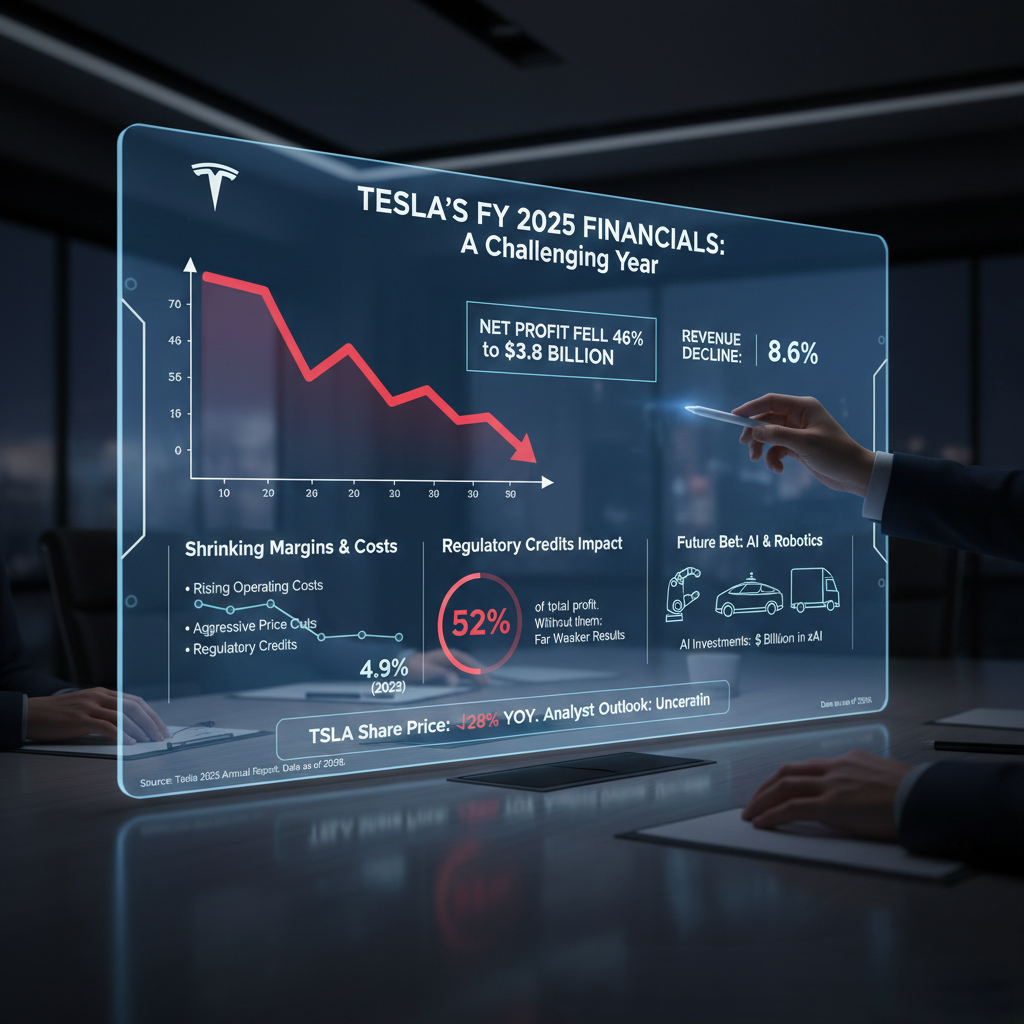
The company’s 2025 financial report reveals net profits fell 46%, dropping to about $3.8 billion. For the first time in history, Tesla also reported a year-over-year decline in total revenue, largely due to an 8.6% drop in vehicle sales.
Shrinking Margins and Rising Costs
Tesla’s profit margins took a sharp hit, falling from 23.8% three years ago to just 4.9% in 2025.
Factors contributing to the squeeze include:
- Rising operating costs
- Aggressive price cuts on vehicles
- Increased reliance on regulatory credits
How Regulatory Credits Affect Tesla’s Bottom Line
Tesla earned roughly $2 billion from selling emissions credits to other automakers.
These credits made up 52% of the company’s total profit. Without them, Tesla’s financial results would have been far weaker.
Energy and Services Provide Some Relief
While the car business struggled, Tesla’s energy storage and services divisions showed double-digit growth.
These segments helped offset losses, but they weren’t enough to fully counter the decline in vehicle sales.
Looking Ahead: AI, Robotics, and Future Projects
Tesla is betting on innovation to restore growth. Key areas include:
- Cybercab robotaxi
- Tesla Semi truck
- Artificial intelligence investments, including $2 billion in xAI
With vehicle sales still declining, the company faces pressure to prove its pivot toward AI and robotics can deliver meaningful results.
What This Means for Investors and the Market
The sharp drop in profits signals a challenging environment for Tesla.
Investors may be watching closely to see whether Tesla’s future-focused projects can offset the slowdown in its core business.
Analysts highlight that Tesla’s dependence on regulatory credits is a risk factor if the market for these credits changes.
Frequently Asked Questions (FAQs)
Why did Tesla’s profits drop so sharply in 2025?
Mainly due to falling vehicle sales, price cuts, and rising operating costs.
How much of Tesla’s profit comes from regulatory credits?
About 52% of total annual profit in 2025 came from selling emissions credits.
Can Tesla bounce back?
The company is betting on AI, robotics, and new vehicle projects to restore growth in 2026 and beyond.
Final Thoughts
Tesla’s 2025 financial report highlights intense pressure on its core business.
While energy and services divisions provide some support, the company’s reliance on regulatory credits and the need to succeed in AI-driven projects are crucial for its future.
The next few years will determine whether Tesla can maintain its leadership in EVs while transitioning into robotics and artificial intelligence.
