


Introduction
Our galaxy may look calm from a distance.
However, new discoveries show that parts of the Milky Way are constantly moving and shifting.
Astronomers recently discovered that a massive ribbon of gas and star-forming material is not stationary. Instead, it moves through space in a wave-like motion.
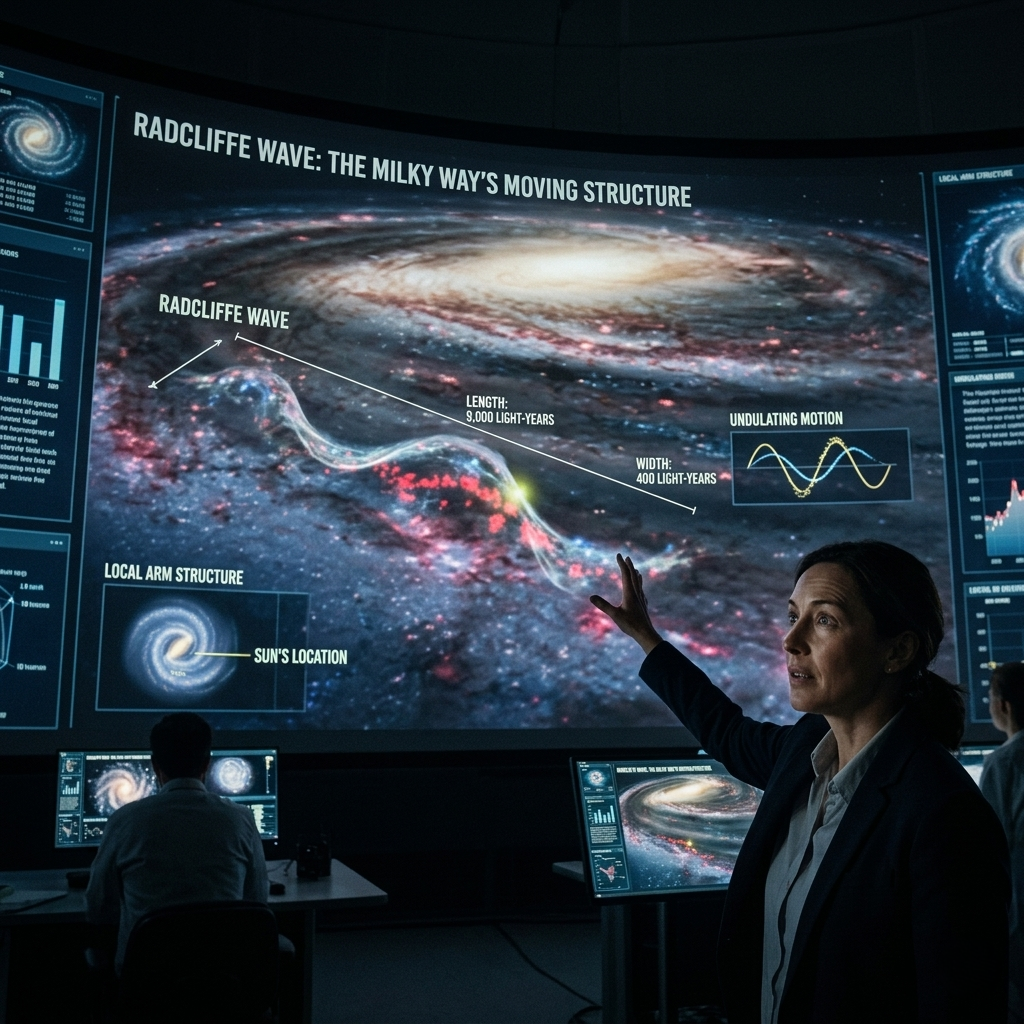
This enormous structure, called the Radcliffe Wave, stretches roughly 9,000 light-years across the galaxy and behaves like a giant cosmic serpent.
What Is the Radcliffe Wave?
The Radcliffe Wave is a huge chain of molecular clouds where new stars form.
These clouds contain the raw materials needed to create stars, including gas and dust. Together, they form a long structure that curves through part of the Milky Way.
Because of its enormous length, the wave connects several well-known stellar nurseries.
These regions include:
- Orion molecular clouds
- Perseus star-forming regions
- Other nearby stellar nurseries
As a result, the Radcliffe Wave plays an important role in the formation of stars near our solar neighborhood.
How Scientists Discovered the Wave’s Motion
Researchers uncovered the movement of the Radcliffe Wave using precise data from the Gaia spacecraft.
This space observatory tracks the position and motion of billions of stars.
Scientists from Harvard University analyzed this data to measure how young stars within the wave move through space.
Their findings revealed something surprising.
Instead of remaining fixed, the entire structure appears to oscillate up and down, much like a wave traveling through water.
Consequently, the Radcliffe Wave moves through the Milky Way in a rhythmic motion.
Why the Wave Moves Like a Cosmic Serpent
The Radcliffe Wave’s movement resembles a slithering motion across the galactic disk.
Astronomers believe this oscillation occurs because of gravitational forces acting on the structure.
Several possible explanations exist:
- Past supernova explosions pushing gas clouds outward
- Gravitational influence from smaller satellite galaxies
- Ancient collisions with massive star clusters
- Large-scale disturbances within the galaxy’s disk
Each of these factors could create waves in the gas clouds that later form stars.
A Surprising Discovery About Gravity
One unexpected result from the study involves gravity.
Researchers found that the Radcliffe Wave’s motion can be explained using only the gravity from visible matter.
This means that scientists do not need to rely on Dark Matter to account for the wave’s behavior in this case.
Although dark matter remains essential for explaining many cosmic phenomena, this discovery shows that ordinary matter can sometimes produce complex galactic motion.
Why This Discovery Matters
The Radcliffe Wave provides a rare opportunity to study large-scale motion within a galaxy.
Understanding how such structures move helps astronomers answer key questions about galaxy evolution.
For example, scientists want to know the following:
- How star-forming regions move over time
- Whether similar waves exist in other galaxies
- What events trigger massive gas oscillations
- How these motions influence star formation
Therefore, studying the Radcliffe Wave may reveal new insights about how galaxies grow and change.
Tracking the Motion of Young Stars
To understand the wave better, astronomers are studying the movement of young stars embedded within it.
Because young stars remain close to the clouds where they formed, their motion helps scientists trace the structure’s movement.
By mapping these stars in three dimensions, researchers can observe how the wave bends, rises, and falls through the galactic disk.
This method provides a powerful tool for studying galactic dynamics.
Could Other Galaxies Have Similar Waves?
One exciting question is whether the Radcliffe Wave is unique.
Astronomers suspect that other galaxies may also contain similar undulating structures.
However, detecting them from Earth is challenging because distant galaxies are harder to observe in detail.
Future telescopes and improved space missions may reveal whether these giant waves exist throughout the universe.
If they do, it would mean galaxies are even more dynamic than scientists previously believed.
Frequently Asked Questions (FAQs)
What is the Radcliffe Wave?
The Radcliffe Wave is a massive chain of star-forming gas clouds stretching about 9,000 light-years across part of the Milky Way Galaxy.
How was the Radcliffe Wave discovered?
Scientists used precise star measurements from the Gaia spacecraft to map the positions and motions of young stars inside the structure.
Why does the Radcliffe Wave move?
Researchers believe gravitational forces, past supernova explosions, or interactions with nearby galactic structures may cause the wave-like motion.
Is dark matter responsible for the wave’s motion?
Current research suggests that the motion of the Radcliffe Wave can be explained using only the gravity of visible matter.
Final Thoughts
The discovery that the Radcliffe Wave moves through space like a cosmic serpent has changed how scientists view our galaxy.
Rather than being static, the Milky Way appears to contain enormous structures that shift, bend, and oscillate over time.
Thanks to precise observations from the Gaia spacecraft, astronomers now have a clearer picture of how star-forming regions move across the galaxy.
As researchers continue studying these massive waves, they may uncover new clues about the forces shaping galaxies throughout the universe.
