


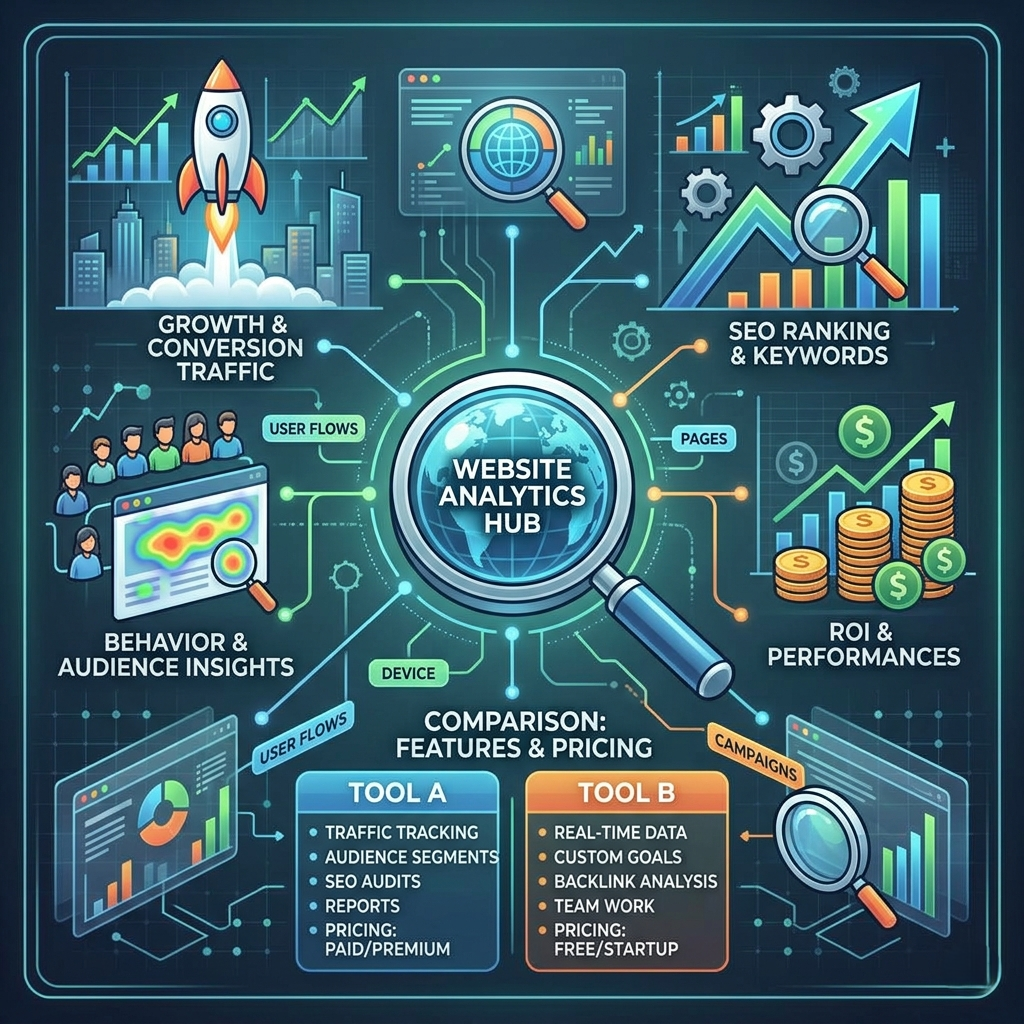
Introduction: Why Analytics Tools Matter More Than Ever
If you want more traffic, you need to understand your visitors first. That’s where website analytics tools come in.
They show what’s working, what’s failing, and where you’re losing users. As a result, you can make smarter decisions and grow faster.
What Are Website Analytics Tools?
Website analytics tools track and report user behavior on your site.
They help you understand:
- Where your visitors come from
- Which pages perform best
- How long users stay
- Why people leave
In short, they turn raw data into useful insights.
1. Google Analytics
Why it’s popular
First of all, Google Analytics is free and powerful. Because of that, it’s the most widely used tool in the world.
Key features
- Real-time traffic tracking
- Audience insights and demographics
- Conversion tracking
- Integration with other Google tools
Best for
Beginners and professionals who want deep insights without spending money.
2. SEMrush
Why it stands out
Unlike basic analytics tools, SEMrush focuses heavily on SEO and competitor research.
Key features
- Keyword tracking and research
- Competitor traffic analysis
- Site audit tools
- Backlink tracking
Best for
Bloggers and marketers who want to rank higher on search engines.
3. Ahrefs
Why people love it
Ahrefs is known for its powerful backlink analysis. Therefore, it’s a favorite among SEO experts.
Key features
- Detailed backlink reports
- Content gap analysis
- Keyword explorer
- Rank tracking
Best for
Advanced users focusing on SEO growth and link-building strategies.
4. Hotjar
What makes it unique
Instead of just numbers, Hotjar shows how users behave visually.
Key features
- Heatmaps (where users click)
- Session recordings
- Feedback polls
- User journey tracking
Best for
Understanding user experience and improving website design.
5. Matomo
Why it’s different
Matomo focuses on privacy. So, it’s a great alternative to Google Analytics.
Key features
- Full data ownership
- GDPR compliance
- No data sharing with third parties
- Customizable dashboards
Best for
Privacy-focused websites and businesses.
6. Clicky
Why choose Clicky
If you want simple and real-time stats, Clicky is a solid choice.
Key features
- Real-time visitor tracking
- Easy-to-read dashboard
- Heatmaps
- Uptime monitoring
Best for
Small websites and bloggers who prefer simplicity.
7. Mixpanel
What it does best
Mixpanel focuses on user actions instead of page views. Therefore, it’s ideal for apps and SaaS platforms.
Key features
- Event-based tracking
- Funnel analysis
- Retention reports
- User segmentation
Best for
Startups and product-based businesses.
How to Choose the Right Analytics Tool
Choosing the right tool depends on your goals.
Ask yourself:
- Do you need SEO insights or user behavior data?
- Are you a beginner or advanced user?
- Is privacy important for your site?
Simple guide:
- For beginners: Google Analytics
- For SEO: SEMrush or Ahrefs
- For UX: Hotjar
- For privacy: Matomo
Real-World Example: Growing Traffic with Analytics
Let’s say you run a blog.
First, you use Google Analytics to find your top pages. Then, you use SEMrush to optimize keywords. After that, Hotjar helps improve user experience.
As a result, your traffic increases without guessing what works.
Common Mistakes to Avoid
Even with the best tools, mistakes can slow you down.
Avoid these:
- Ignoring data insights
- Tracking too many metrics at once
- Not setting clear goals
- Failing to test changes
Instead, focus on actionable data and consistent improvement.
FAQs
Which is the best free analytics tool?
Google Analytics is the best free option for most users.
Do I need multiple analytics tools?
Yes, combining tools gives better insights. For example, use one for SEO and another for user behavior.
Are analytics tools hard to use?
Not really. Many tools offer simple dashboards and tutorials for beginners.
Can analytics tools improve SEO?
Yes, they help you understand keywords, traffic sources, and user behavior, which improves SEO.
Final Thoughts: Turn Data Into Growth
Website analytics tools are no longer optional; they’re essential.
If you want to grow your traffic, you must understand your audience. Once you do that, every decision becomes smarter and more effective.
