


Introduction
Facial recognition is everywhere now.
From airports to shopping malls, cameras quietly scan faces every day.
A new invention from the Netherlands is challenging this growing surveillance culture—without breaking laws or hiding identities.
A New Way to Protect Privacy in Public Spaces
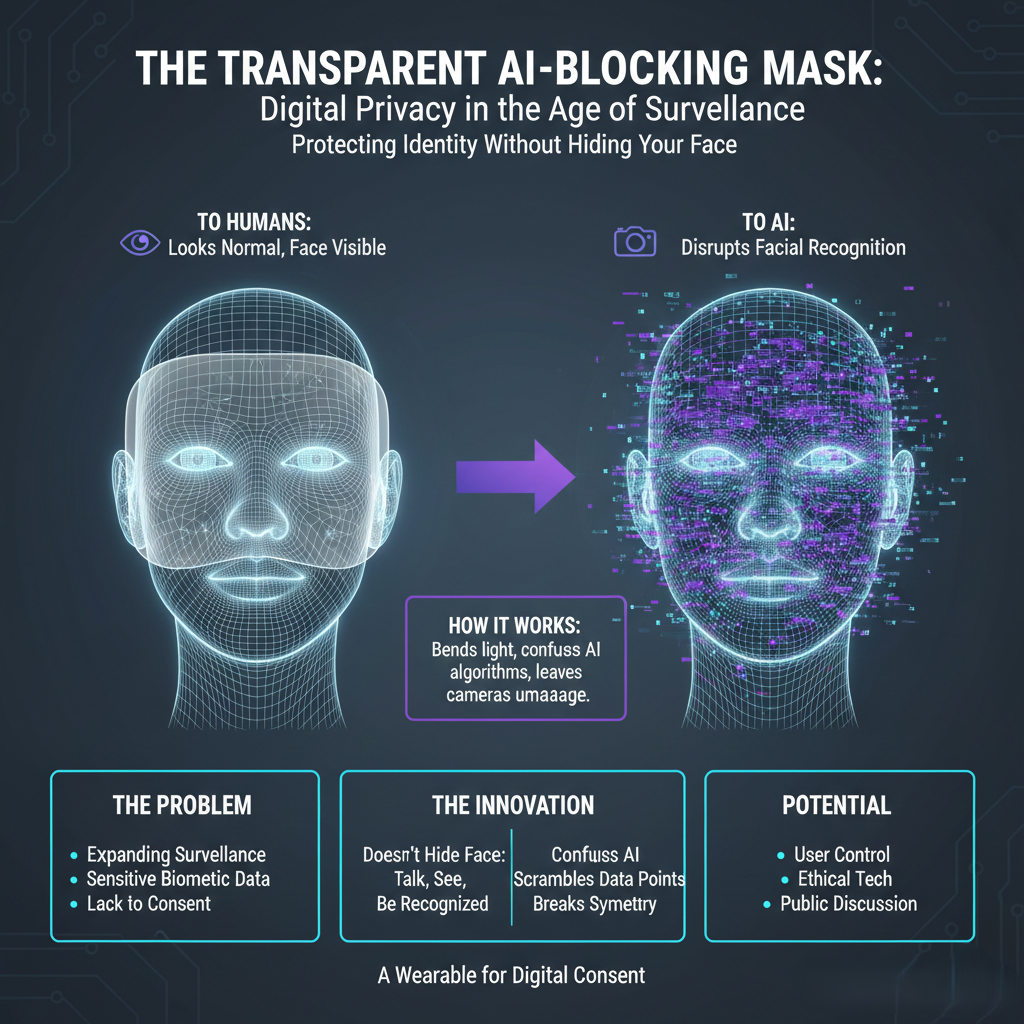
A Dutch designer has created a transparent privacy mask that looks normal to people but disrupts AI facial recognition systems.
To the human eye, the mask appears clear and harmless.
To AI systems, it creates confusion.
How the Transparent AI-Blocking Mask Works
It Doesn’t Hide the Face
Unlike traditional masks or face coverings, this design keeps the face fully visible.
People can still:
- Talk normally
- Make eye contact
- Be recognized by friends and colleagues
It Confuses AI, Not Humans
The mask contains subtle optical patterns built into the material.
These patterns:
- Bend light in specific ways
- Disrupt facial reference points
- Confuse AI detection algorithms
Facial recognition software relies on
- Eye distance
- Nose shape
- Facial symmetry
The mask interferes with these markers.
No Damage to Cameras or Systems
An important detail:
The mask does not block, blind, or damage cameras.
Instead, it simply changes how visual data is captured.
This makes it:
- Legal in many regions
- Non-invasive
- A passive privacy tool
Why Facial Recognition Is Raising Concerns
Surveillance Is Expanding Fast
AI-powered face scanning is now used in:
- Airports
- Retail stores
- Smart cities
- Public transport systems
Many people are scanned without knowing it.
Biometric Data Is Extremely Sensitive
Facial data is permanent.
You can’t change your face like a password.
This raises serious questions:
- Who owns facial data?
- How long is it stored?
- Who has access to it?
Wearable Tech Focused on Digital Consent
This mask represents a new category of wearable privacy technology.
Instead of rejecting technology, it works with it—in a protective way.
Key goals include:
- Giving people more control
- Encouraging transparency
- Starting public discussion
Real-World Impact and Future Use
As facial recognition expands, tools like this could be used by:
- Privacy advocates
- Journalists
- Protesters
- Everyday citizens
It also pushes governments and companies to rethink ethical data use.
Is This the Future of Privacy Protection?
This project shows that innovation doesn’t always mean more surveillance.
Sometimes, it means:
- Smarter resistance
- Ethical design
- User-first technology
Privacy-focused wearables may soon become as common as smartwatches.
Final Thoughts
The transparent, AI-disrupting mask isn’t about hiding.
It’s about choice and consent.
As surveillance technology grows, people are asking for balance.
This invention proves that design and innovation can help protect identity—without going offline.
