


Introduction: More Than Just a Bone Vitamin
Most people think of Vitamin D3 as the “bone vitamin.”
It helps absorb calcium and supports immunity.
That’s what we’ve known for years.
But new research suggests it may do something much deeper.
Scientists now believe Vitamin D3 could help slow biological aging at the cellular level.
The idea isn’t about living forever.
It’s about helping cells stay healthier for longer.
What Sparked the Interest?
The excitement comes from findings linked to the VITAL trial.
This large clinical study explored the effects of Vitamin D and omega-3 supplements on long-term health outcomes.
Some related findings suggest that taking around 2,000 IU of Vitamin D3 daily may slow cellular aging by nearly three years.
That doesn’t mean it reverses aging.
It means it may slow down some internal aging markers.
How Vitamin D3 May Influence Aging
Let’s break this down in a simple way.
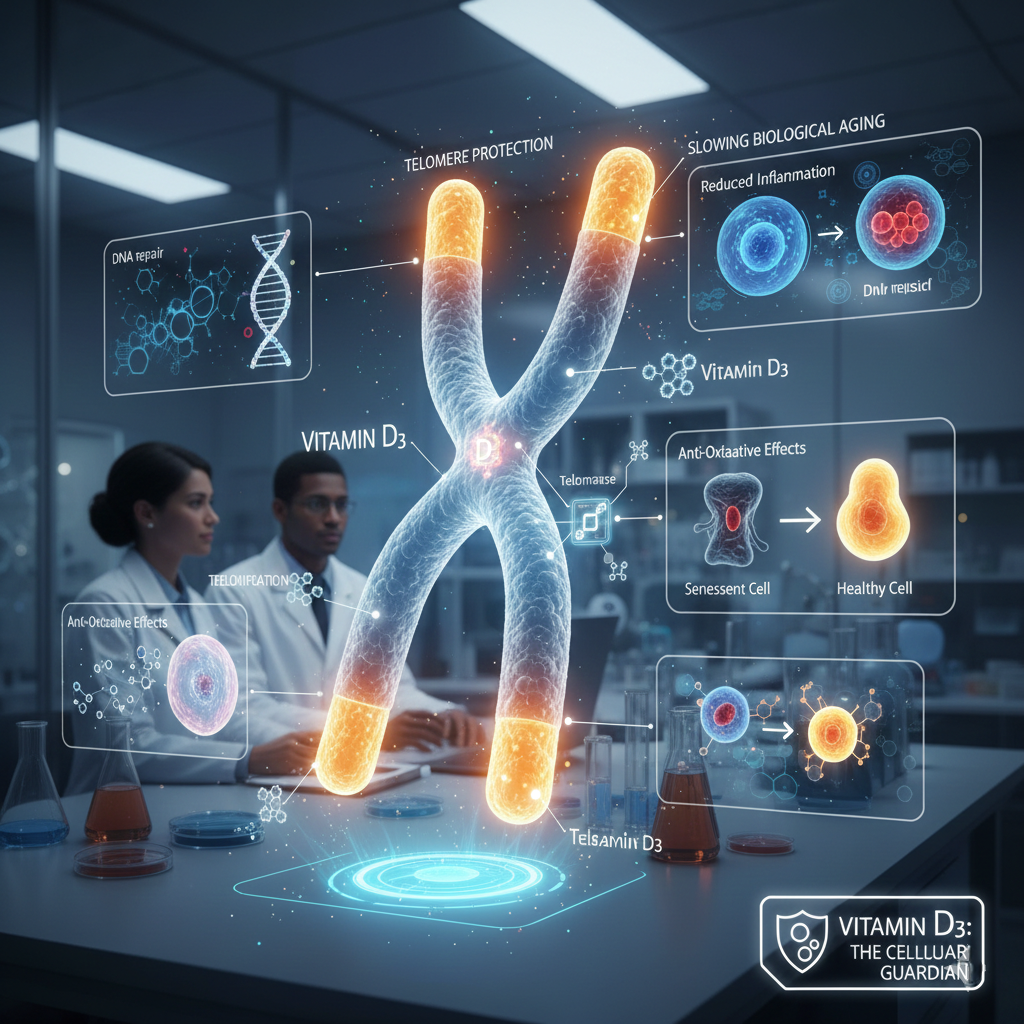
1. Protecting Telomeres
Telomeres are tiny protective caps at the ends of chromosomes.
Every time a cell divides, these caps get shorter.
Shorter telomeres are linked to aging and disease.
Research suggests Vitamin D3 may slow this shortening process.
In one long-term study, people taking Vitamin D lost around 140 fewer DNA base pairs compared to a placebo group.
Vitamin D may also increase telomerase activity.
Telomerase is the enzyme that helps rebuild and maintain telomeres.
That’s one reason scientists are paying attention.
2. Slowing the Biological Clock
Aging isn’t just about how many birthdays you’ve had.
It’s also about how your genes behave over time.
Vitamin D interacts with the Vitamin D receptor (VDR), which helps control hundreds of genes linked to:
- DNA repair
- Cell maintenance
- Immune response
- Inflammation control
Researchers measure internal aging using “epigenetic clocks,” based on DNA methylation patterns.
Some studies suggest Vitamin D supplementation may slightly slow this internal clock.
It’s not dramatic.
But even small changes can matter long term.
3. Reducing Cellular Stress
Chronic inflammation plays a major role in aging.
Scientists often call it “inflammaging.”
Vitamin D has strong anti-inflammatory effects.
It helps lower long-term cellular stress and may reduce oxidative damage.
Less oxidative damage means fewer errors in DNA over time.
That supports healthier aging at the cellular level.
4. Delaying Cellular Senescence
As cells age, some stop dividing but don’t die.
Instead, they release harmful inflammatory signals.
These are sometimes called “zombie cells.”
Vitamin D may help delay this stage by supporting overall cellular health.
Healthier cells mean fewer harmful signals circulating in the body.
What This Really Means (And What It Doesn’t)
Let’s be clear.
Vitamin D3 is not a miracle anti-aging pill.
The findings are promising, but they’re not final.
Many factors influence aging, including:
- Sleep quality
- Nutrition
- Physical activity
- Sunlight exposure
- Stress levels
Vitamin D appears to be one supportive piece of a much larger puzzle.
A Real-World Perspective
In clinical settings, doctors often recommend Vitamin D3 for people who are deficient.
Deficiency is common, especially in regions with limited sun exposure.
Correcting low levels already improves bone health and immune function.
If it also supports healthy aging, that’s an added benefit.
But supplementation should be based on blood levels and medical guidance.
More isn’t always better.
Frequently Asked Questions
How much Vitamin D3 was studied?
Around 2,000 IU per day in research linked to the VITAL trial.
Can Vitamin D3 reverse aging?
No. It may slow certain biological aging markers, but it does not stop aging.
Is it safe to take 2,000 IU daily?
For many adults, it’s considered safe. Still, it’s best to check with a healthcare provider.
Should everyone take Vitamin D for anti-aging?
Not necessarily. Blood testing helps determine if supplementation is needed.
Why This Research Matters
Aging science is changing.
Instead of focusing only on appearance, researchers now study cellular health.
The goal isn’t just to treat disease after it appears.
It’s to slow biological decline before serious problems begin.
Vitamin D3 is becoming an interesting candidate in that shift.
If future studies confirm these results, it could become part of broader healthy-aging strategies.
Final Thoughts: A Support Tool, Not a Shortcut
The research is exciting.
But it should be viewed carefully and realistically.
Vitamin D3 may help protect telomeres, reduce inflammation, and support DNA repair.
That’s important.
Still, no supplement replaces a healthy lifestyle.
Think of Vitamin D as a supportive tool — not a shortcut.
Healthy aging is built on consistent daily habits.
Supplements can help.
But they work best alongside smart lifestyle choices.
