

Close Menu
Innovate And ExploreInnovate And Explore

    Subscribe to Updates

    Get the latest creative news from FooBar about art, design and business.

    What's Hot

    This Hydrogen Stove Uses Water Instead of Gas: How It Works

    April 19, 2026

    Utah Measles Outbreak: Why Cases Are Rapidly Rising

    April 19, 2026

    Why AI Tools Are Driving Massive Traffic in 2026

    April 19, 2026
    Facebook Instagram
    Facebook Instagram YouTube TikTok
    Innovate And ExploreInnovate And Explore
    • Artificial Intelligence
    • Medical Research
    • Technology News
    • Science News
    • VR Headset
    • Palantir
    Innovate And ExploreInnovate And Explore
    Home » Watermelon Rind and Cancer Research: What Scientists Found
    Medical Research

    Watermelon Rind and Cancer Research: What Scientists Found

    alfredBy alfredFebruary 19, 2026No Comments4 Mins Read
    Facebook Twitter Pinterest LinkedIn Tumblr WhatsApp Email
    Share
    Facebook Twitter LinkedIn WhatsApp Pinterest Email

    Most of us eat the juicy red part of watermelon and throw the rest away.

    But scientists are now looking at the white rind—and the results are surprising.

    Lab studies suggest that compounds in watermelon rind may have strong biological activity against certain cancer cells.

    Let’s break down what this really means.

    What Did the Study Show?

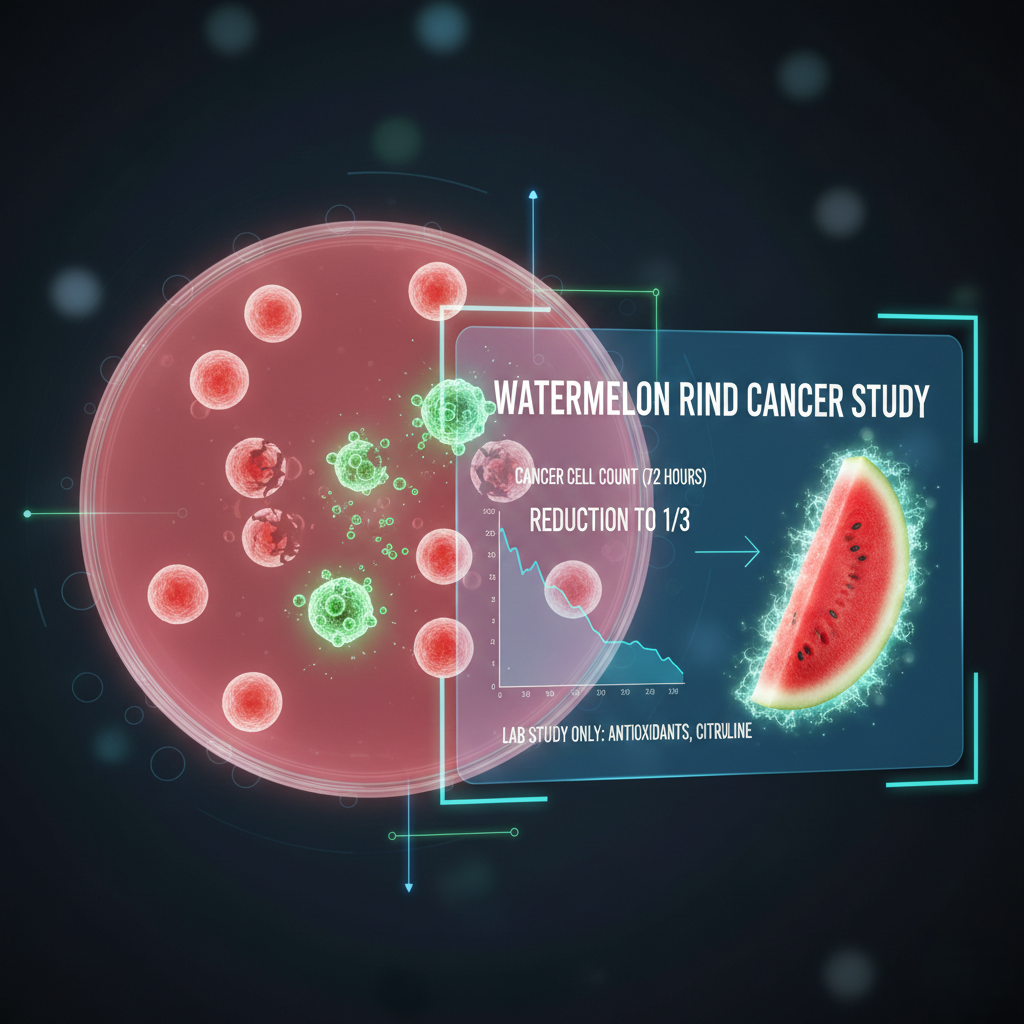
    In controlled laboratory experiments, researchers tested extracts made from watermelon rind on kidney cancer cells.

    Within three days, the number of cancer cells dropped to about one-third of their original count.

    That’s a significant reduction.

    However, these tests were done in lab dishes—not in human patients.

    That distinction is very important.

    Why the Rind May Be Biologically Active

    The white rind isn’t just fiber. It contains several compounds that scientists are interested in:

    • Antioxidants
    • Citrulline
    • Phenolic compounds

    These substances may:

    • Reduce oxidative stress
    • Support cellular repair processes
    • Interfere with abnormal cell growth

    Citrulline, in particular, is known to support blood flow and nitric oxide production.

    But its role in cancer research is still being explored.

    Lab Results vs. Real-Life Treatment

    It’s easy to see exciting headlines and think, “So eating watermelon rind cures cancer?”

    The answer is no.

    Lab results are an early step in research.

    Many substances can slow cancer cells in a petri dish. Far fewer prove effective and safe in humans.

    Before any medical claim can be made, researchers would need:

    1. Animal studies
    2. Human clinical trials
    3. Safety evaluations
    4. Proper dosage testing

    We are not at that stage yet.

    Why This Research Still Matters

    Even though this is early-stage research, it highlights something important.

    Everyday foods may contain overlooked compounds with powerful biological effects.

    Many modern medicines originally came from plants.

    For example:

    • Aspirin came from willow bark.
    • Some chemotherapy drugs were derived from plant compounds.

    Studying food-based compounds can lead to new discoveries.

    The rind, once considered waste, may hold useful chemical properties.

    Could You Add Watermelon Rind to Your Diet?

    Watermelon rind is edible.

    In some cultures, it is:

    • Pickled
    • Stir-fried
    • Blended into smoothies
    • Used in jams

    It’s rich in fiber and contains nutrients.

    But again, eating it has not been proven to treat or prevent cancer.

    It can be part of a balanced diet—not a replacement for medical care.

    What Scientists Will Study Next

    Future research may focus on:

    • Identifying the exact active compounds
    • Understanding how they affect cancer pathways
    • Testing in animal models
    • Designing human clinical trials

    If results continue to show promise, pharmaceutical development could follow.

    That process usually takes years.

    FAQs

    1. Does watermelon rind cure cancer?

    No. The findings are from lab studies only. There is no proof it treats or prevents cancer in humans.

    2. What type of cancer was studied?

    The research focused on kidney cancer cells in laboratory conditions.

    3. What compounds in the rind may be helpful?

    Scientists point to antioxidants, citrulline, and phenolic compounds as possible contributors.

    4. Is watermelon rind safe to eat?

    Yes, it is generally safe and edible when washed properly. However, it should not replace medical treatment.

    5. Why are lab results important?

    Lab studies help identify promising compounds. They are the first step in a long scientific process.

    Final Thoughts

    The white rind of a watermelon might not deserve the trash bin so quickly.

    Early lab research suggests it contains compounds that can significantly reduce kidney cancer cells under controlled conditions.

    But early findings are not final answers.

    What this study really shows is how much we still have to learn about everyday foods.

    Sometimes, health discoveries hide in plain sight.

    As research continues, watermelon rind may turn out to be more valuable than we ever imagined—not as a miracle cure, but as a source of promising scientific insight.

    advanced encryption standard ai chatgpt ai science news artificial general intelligence california science center hologram museum medical research palantir quantum physics science center science fair board science museum scientific method tech news virtual reality headset
    Share. Facebook Twitter Pinterest LinkedIn Tumblr WhatsApp Email
    alfred

    Related Posts

    This Hydrogen Stove Uses Water Instead of Gas: How It Works

    April 19, 2026

    Utah Measles Outbreak: Why Cases Are Rapidly Rising

    April 19, 2026

    Why AI Tools Are Driving Massive Traffic in 2026

    April 19, 2026

    Lake Mead Water Crisis: Why Water Levels Are Falling Fast

    April 18, 2026

    New York AI Law 2026: Why Chatbots Could Face Lawsuits

    April 18, 2026

    Is AI Quietly Making Life More Expensive? Here’s What You Should Know

    April 18, 2026
    Add A Comment
    Leave A Reply Cancel Reply

    Don't Miss

    This Hydrogen Stove Uses Water Instead of Gas: How It Works

    By alfredApril 19, 2026

    Introduction: Cooking Without Gas Is Now Possible Imagine cooking your meals without a gas cylinder…

    Utah Measles Outbreak: Why Cases Are Rapidly Rising

    April 19, 2026

    Why AI Tools Are Driving Massive Traffic in 2026

    April 19, 2026

    Lake Mead Water Crisis: Why Water Levels Are Falling Fast

    April 18, 2026
    Stay In Touch
    • Facebook
    • Twitter
    • Pinterest
    • Instagram
    • YouTube
    • Vimeo
    Our Picks

    This Hydrogen Stove Uses Water Instead of Gas: How It Works

    April 19, 2026

    Utah Measles Outbreak: Why Cases Are Rapidly Rising

    April 19, 2026

    Why AI Tools Are Driving Massive Traffic in 2026

    April 19, 2026

    Lake Mead Water Crisis: Why Water Levels Are Falling Fast

    April 18, 2026

    Subscribe to Updates

    Get the latest creative news from SmartMag about art & design.

    Techlo Inno
    Innovate And Explore
    Facebook Instagram YouTube TikTok
    • About Us
    • Cookies Policy
    • Editorial Policy
    • Terms & Conditions
    © 2026 Innovate and Explore. Designed by Techlo Inno.

    Type above and press Enter to search. Press Esc to cancel.

    Powered by
    ►
    Necessary cookies enable essential site features like secure log-ins and consent preference adjustments. They do not store personal data.
    None
    ►
    Functional cookies support features like content sharing on social media, collecting feedback, and enabling third-party tools.
    None
    ►
    Analytical cookies track visitor interactions, providing insights on metrics like visitor count, bounce rate, and traffic sources.
    None
    ►
    Advertisement cookies deliver personalized ads based on your previous visits and analyze the effectiveness of ad campaigns.
    None
    ►
    Unclassified cookies are cookies that we are in the process of classifying, together with the providers of individual cookies.
    None
    Powered by