


Artificial intelligence is often celebrated as a breakthrough technology.
Smarter systems, faster decisions, and powerful automation dominate the conversation.
But behind the screens and algorithms lies a growing concern.
AI’s infrastructure may be placing an enormous strain on the planet.
Emerging research suggests its footprint now rivals that of major megacities.
Why AI Requires So Much Energy
Modern AI models don’t run on laptops.
They rely on vast networks of data centers operating around the clock.
These facilities power:
- Cloud computing services
- Large language models
- Image and video generation systems
- Real-time AI applications
As models grow larger and more complex, their energy demands rise sharply.
AI Data Centers vs. Major Cities
A study published in Patterns projects a striking comparison.
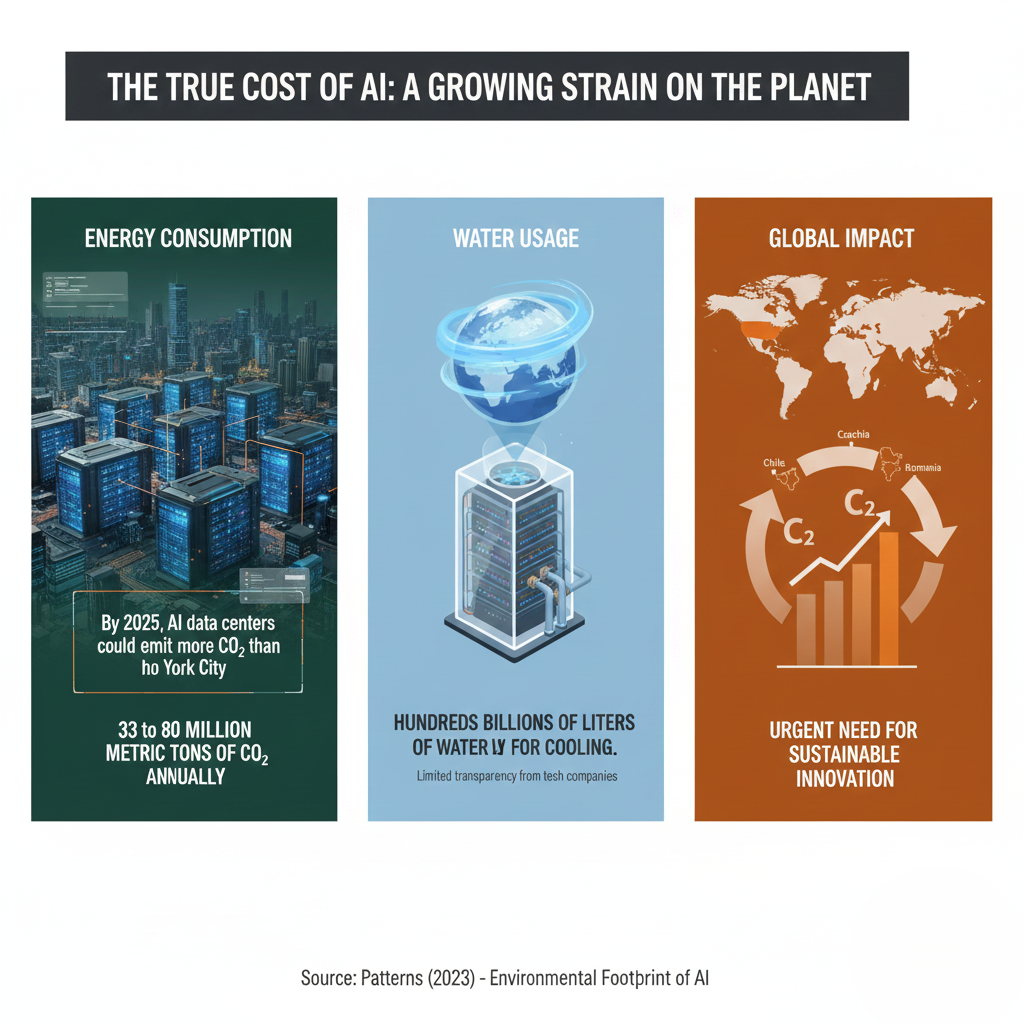
By 2025, AI-driven data centers could emit more carbon than New York City.
What the Research Suggests
Researchers estimate AI-related operations may already generate:
- 33 to 80 million metric tons of CO₂ annually
That range could surpass the yearly emissions of entire countries, including:
- Chile
- Czechia
- Romania
This places AI among the fastest-growing sources of digital emissions.
Why Emissions Are Rising So Quickly
Several factors are driving this surge:
- Explosive growth in cloud services
- Increasing model size and training frequency
- Always-on AI applications
- Global demand for real-time processing
Training a single large AI model can consume as much energy as thousands of homes use in a year.
The Overlooked Issue: Water Consumption
Electricity isn’t the only resource under pressure.
AI infrastructure also consumes massive amounts of water.
Data centers rely heavily on water-based cooling systems.
These prevent servers from overheating during continuous operation.
Estimated Water Impact
Experts warn that AI facilities may soon use hundreds of billions of liters of water each year.
This raises concerns in regions already facing water scarcity.
Why the True Impact Is Hard to Measure
One major challenge is transparency.
Many AI companies do not fully disclose energy or water usage.
Researchers caution that current estimates may be conservative.
The real environmental footprint could be significantly higher.
Without standardized reporting, accountability remains limited.
Global AI Adoption Is Accelerating
AI integration is expanding across industries:
- Healthcare
- Finance
- Transportation
- Education
- Manufacturing
As adoption grows, so does infrastructure demand.
Without intervention, environmental costs may rise faster than benefits.
Can AI Innovation Become More Sustainable?
Experts stress that progress doesn’t have to come at the planet’s expense.
Potential Solutions Include
- Energy-efficient model design
- Renewable-powered data centers
- Improved cooling technologies
- Transparent environmental reporting
- Smarter deployment of AI workloads
Sustainable AI is becoming a critical research priority.
Frequently Asked Questions (FAQs)
Is AI worse for the environment than other technologies?
AI’s rapid scaling makes its environmental impact grow faster than many traditional systems.
Do all AI systems consume massive energy?
No. Smaller, optimized models use far less energy than large-scale systems.
Can regulation reduce AI’s footprint?
Clear standards and reporting requirements could significantly improve accountability.
The Bigger Picture: Intelligence vs. Responsibility
Artificial intelligence is reshaping the future.
But innovation without sustainability carries long-term risks.
As AI grows more powerful, its environmental footprint must be addressed just as seriously as its capabilities.
