


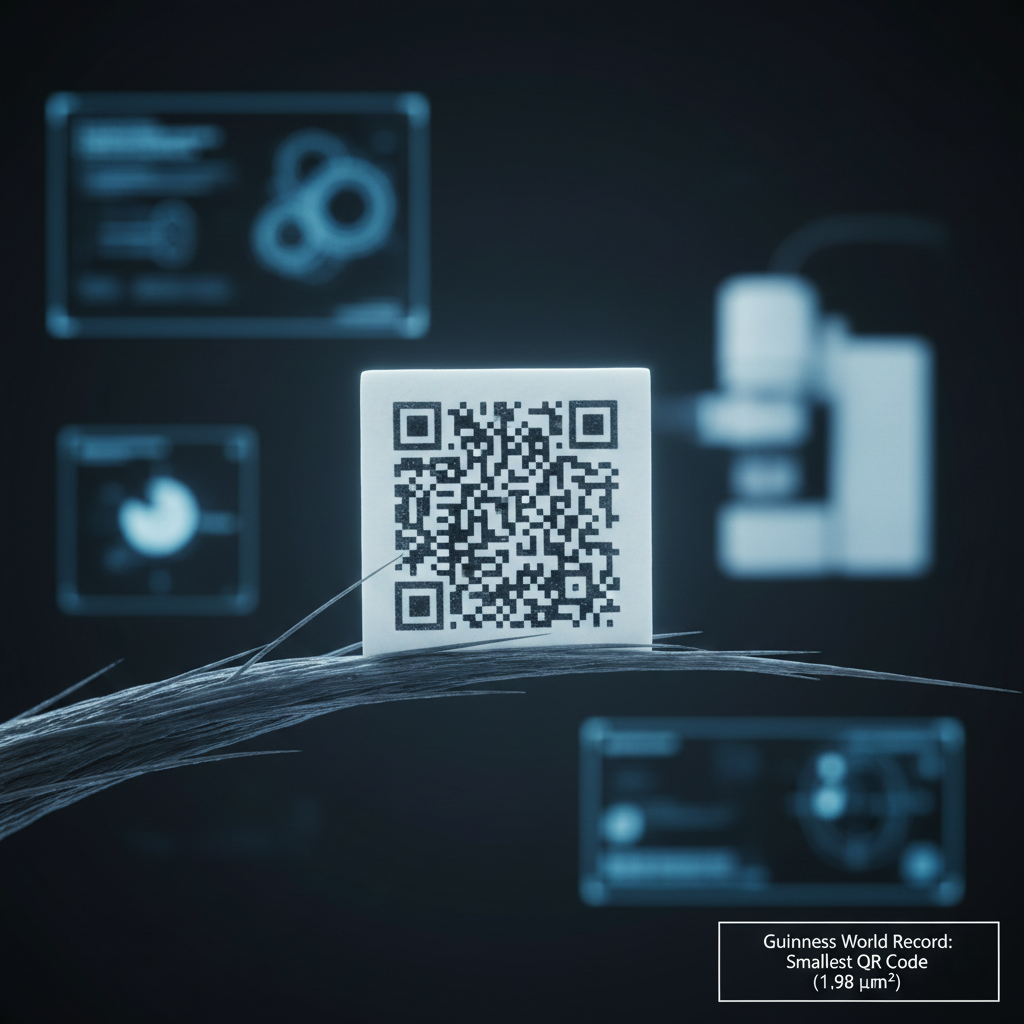
Imagine shrinking a QR code so small that it’s invisible to the human eye.
That’s exactly what researchers at the Vienna University of Technology have done—creating the world’s smallest QR code, officially recognized by Guinness World Records.
This isn’t just a cool record. It could change how we store information for the future.
How Small Is the World’s Smallest QR Code?
The tiny QR code measures just 1.98 square micrometers.
To put that into perspective:
- It’s smaller than many bacteria
- Invisible without powerful microscopes
- Smaller than the width of a human hair by thousands of times
Each pixel inside the QR code is only 49 nanometers wide.
That’s precision at an almost unbelievable scale.
How Did Scientists Create It?
The team used a highly advanced method called focused ion beam technology.
Instead of printing ink, they:
- Took an ultra-thin ceramic surface
- Used ion beams to carefully carve the QR pattern
- Controlled each nanoscale pixel with extreme precision
This process allows engineers to shape materials atom by atom.
It’s like engraving a microscopic masterpiece.
Why This Is More Than Just a World Record
At first glance, this may look like a simple scientific stunt.
But it’s actually a major breakthrough in nanoscale data storage.
The ceramic material used in the experiment is
- Extremely stable
- Resistant to environmental damage
- Able to preserve information without electricity
That last point is important.
Most modern storage systems—hard drives, SSDs, cloud servers—require continuous power and maintenance.
This nano-engraved ceramic does not.
The Future of Ultra-Durable Data Storage
One of the biggest problems in digital history is data loss.
Files get corrupted.
Drives fail.
Cloud services shut down.
But ceramic-based nano storage could change that.
Researchers believe this technology could:
- Preserve cultural archives
- Store legal or government records
- Protect scientific research data
- Safeguard historical documents
And potentially keep information intact for hundreds of years.
That’s long-term digital preservation on a whole new level.
Real-World Comparison: Traditional vs Nano Storage
Let’s keep it simple.
Traditional Storage
- Requires electricity
- Limited lifespan (5–20 years for many drives)
- Sensitive to heat and moisture
- Needs backups
Nano-Ceramic Storage
- No electricity required
- Extremely stable material
- Resistant to environmental damage
- Designed for ultra-long preservation
It’s not about replacing cloud storage tomorrow.
It’s about building archives that last centuries.
Why Nanotechnology Matters Here
Nanotechnology allows scientists to engineer materials at the scale of atoms and molecules.
When you can carve a QR code smaller than bacteria, it shows:
- Data density can reach extreme levels
- Information can be permanently etched
- Physical storage can become incredibly compact
This experiment proves how far nanoscale engineering has come.
And we’re likely just getting started.
FAQs
What is the size of the world’s smallest QR code?
It measures just 1.98 square micrometers, making it smaller than many bacteria and invisible without advanced microscopes.
Who created the smallest QR code?
Researchers at the Vienna University of Technology developed it, and Guinness World Records officially recognized the achievement.
How was the QR code made?
Scientists used focused ion beam technology to carve the pattern onto an ultra-thin ceramic surface at the nanoscale.
Can this technology replace hard drives?
Not immediately. However, it shows strong potential for ultra-durable archival storage systems in the future.
Why is ceramic used for storage?
Ceramic is extremely stable and does not require electricity to preserve information, making it ideal for long-term data protection.
Final Thoughts
The world’s smallest QR code is more than a scientific milestone.
It shows how nanotechnology is reshaping the limits of information storage.
While it may not replace your USB drive tomorrow, it opens the door to a future where important data can survive for centuries without power.
That’s not just a record.
That’s a glimpse into the next era of digital preservation.
